


[Report] Top Low-Competition Keywords With High Traffic Potential
See which keywords have the lowest competition and are easiest to rank for across all industries in 2026.



Our AI agents catch the sophisticated fraud others miss and it tells you why. Learn more here.



Click fraud is costing advertisers billions in loses. Learn more here.

Click fraud is costing advertisers billions in loses. Learn more here.



Read our in-depth study by independent research firm Juniper Research.



 Top ad fraud statistics at a glance
22% of global digital advertising spend is lost to fraud every year, according to our own research. For advertisers spending $10,000 per month, that could mean $2,200 disappearing into fraudulent clicks, fake impressions, and bot traffic.
But the problem doesn’t stop there. In 2024, bad bots accounted for 37% of all web traffic, up from 32% in 2023 [Statistica]. That means more than a third of the “visitors” interacting with digital ads are actually automated programs designed to drain advertising budgets and scrape data.
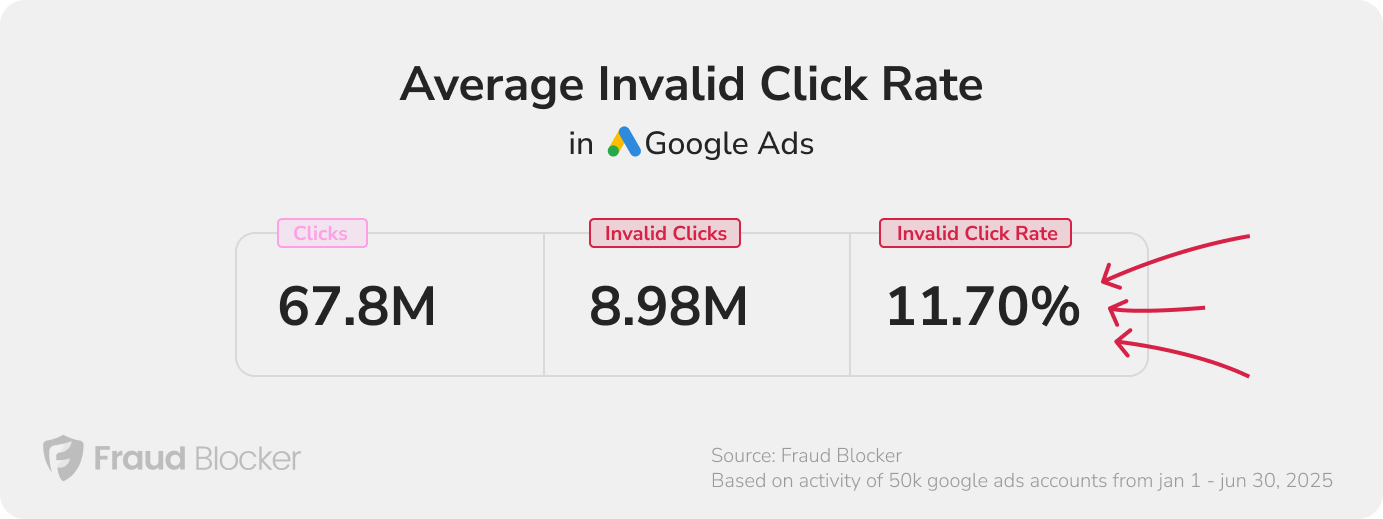
For PPC campaigns specifically, the numbers are equally stark. Our analysis of thousands of Google Ads accounts reveals an average invalid click rate of 11.4%.
There are also worrying trends within programmatic ads, and even the fraud prevention strategies that ad platforms put in place.
So let’s look at the latest ad fraud and click fraud statistics for 2026, get an overview of the industry, and share the most important numbers advertisers need to know.

You might find different numbers and estimates when researching ad fraud statistics, and here’s why:
Definition scope matters.
Our research found that about $84 billion was lost to ad fraud in 2023. This narrows on deliberate “ad fraud” (click bots, fake impressions, and clearly fraudulent schemes). But broader estimates can be higher, especially if we include all “invalid traffic,” which lumps in accidental clicks, low-quality placements, and non-human interactions that still waste budget.
Ad platforms have basic fraud protections, but they don’t have the incentive to aggressively flag invalid clicks since it reduces their revenue. In fact, Reuters reports that Meta’s own internal documents estimate up to $16 billion in 2024 revenue tied to scam activity and ads for banned products [Reuters].
Read more: How does Google Ads prevent click fraud?
Not all campaign types face equal fraud exposure. Search campaigns typically see the highest rate of invalid clicks. This is because they target high-intent keywords where click costs are higher, so, they are more attractive targets for competitor clicks and bot networks. Display campaigns will generally have a lower invalid click rate.
There are high-risk industries as well, like the legal, insurance, finance, and healthcare industries. Here, campaigns may see invalid click rates well above the average, without adequate click fraud protection.
Our 11.5% figure was based on 96 million ad clicks across 85,000 accounts and 24,582 active Google Ad campaigns. This includes all campaign types.
For a business spending $10,000 per month on Google Ads with an 11.5% invalid click rate wastes $1,380 every month, and $16,560 annually. Scale that to enterprise budgets of $100,000+ per month, and you’re looking at six-figure (at least $138,000) annual losses to fraudulent clicks alone.
The fake traffic problem can show up in different ways across your digital properties. It could be fake website sessions or fake paid visitors. Fake paid visitors are particularly problematic because you’re directly paying for them. Major advertising platforms regularly see 10% to 25% of paid traffic coming from non-human sources.
The real problem isn’t just your wasted budget (although that’s a huge part of it); it’s also the cascade of problems that it brings, like the following:
Made-for-advertising sites represent one of programmatic’s most persistent problems. These sites drain budgets, deliver extremely low engagement rates, and still manage to look legitimate. Here’s how they operate:
Even when traffic is technically valid, MFA sites and misaligned placements can severely worsen your effective return. A click from a bot farm and a click from someone reading listicles for rewards are both problematic, just in different ways.
Advertisers are shifting budgets to Connected TV, and fraudsters are following. With average CPMs ranging $25-$35 [Adwave] (significantly higher than most digital channels), CTV represents one of the most lucrative fraud targets today.
Connected TV lacks standard cookie-based tracking, making it harder to verify that ads reached real viewers. This opacity creates ideal conditions for fraud, and so we see bot fraud accounting for 65% of all CTV fraud.
Findings also suggest that Server-Side Ad Insertion (SSAI) has become the primary attack vector. While SSAI creates smoother viewing experiences, invalid traffic rates jump 140% higher when SSAI is present. Fraudsters spoof SSAI servers to generate fake impressions that appear legitimate, costing unprotected advertisers millions.
Unfortunately, it’s impossible to have 0% invalid click rates. Even with the most sophisticated fraud protection, some invalid traffic will always slip through because not all invalid clicks are malicious. There are accidental mobile taps, curious competitors manually checking your ads, and edge cases of legitimate users exhibiting bot-like behavior.
Additionally, fraudsters constantly develop new evasion techniques that haven’t been cataloged yet, and so, the fraud protection system isn’t yet looking out for them.
The goal of fraud protection is to minimize waste to levels that don’t materially impact your ROAS, not to achieve a theoretically perfect, but practically impossible zero.
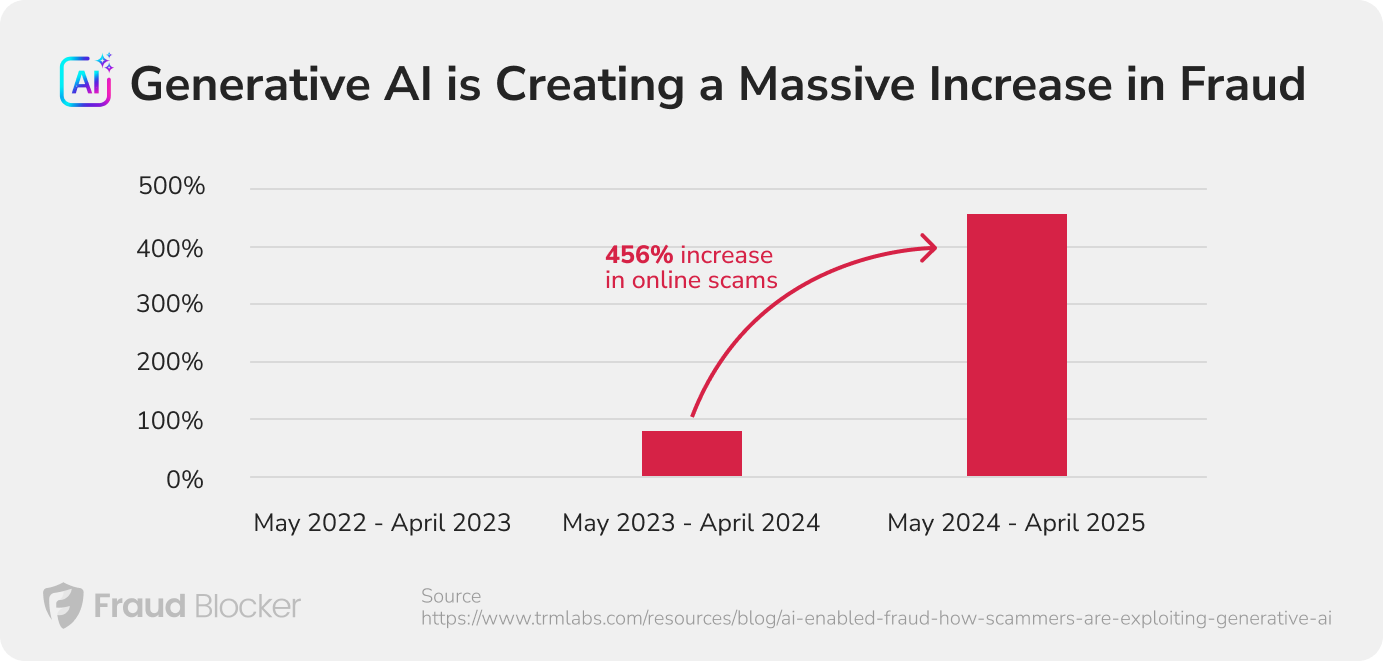
Search volume for “AI ad fraud” is skyrocketing, and the statistics reveal why. Generative AI has changed the fraud landscape, making it easier to power more sophisticated attacks. Even though it’s not marketed as such, fraudsters can basically employ them as a form of fraud-as-a-service and launch fraud on a massive scale, for as little as $20.
With deepfake, for example, attempts powered by the technology occurred every five minutes in 2024.
And beyond malicious deepfakes, AI has triggered an explosion in General Invalid Traffic (GIVT) through AI scrapers like GPTBot, ClaudeBot, and AppleBot. These bots scan the web to train large language models, inflating impression counts without human eyes ever seeing ads. While not inherently malicious like other kinds of fraud, AI scrapers can corrupt analytics data and create measurement challenges for advertisers.
A new category of AI-powered traffic is emerging: agentic browsers like Perplexity’s Comet and OpenAI’s ChatGPT agent mode. These AI-first browsers render webpages while interpreting content, executing tasks.
Research from Seer Interactive and MarTech shows that traffic from these agentic browsers often masks its origin, blending with direct traffic in Google Analytics, rather than appearing as a clear referral source.
For these browsers, the measurement challenge becomes identifying them from real users who can convert. The distinction matters for attribution, audience building, and campaign performance analysis.

Screenshot of Fraud Blocker’s dashboard
The data is clear: ad fraud is a massive, growing problem that affects every advertiser regardless of budget size or industry. They represent real money leaking from your campaigns every single day.
The good news is that fraud mitigation platforms can help.
Fraud Blocker protects over 4,500 websites and analyzes more than 500,000 unique IP behaviors daily, monitoring 60 million+ IPs and 20,000+ domains for fraudulent activity. Our solution offers real-time protection by tracking IP addresses, device and browser fingerprints, VPN/proxy use, click frequency, and a bunch of other signals, and then blocking invalid traffic, where detected, before it wastes your budget.
Start a 7-day free trial to see how much your actual invalid click rate is, and how Fraud Blocker can protect your campaigns.
Estimates vary due to different definitions (narrow ‘ad fraud’ vs broader ‘invalid traffic’), different channels measured (programmatic display vs all digital), and different methodologies and time frames.
Ad fraud refers to intentional deception for financial gain (bots, click farms). Invalid traffic is broader, including accidental clicks, misattributed conversions, and non-human activity that may not be malicious but still wastes spend. Learn more.
Platforms like Google and Meta have built-in protections, but they catch only a portion of invalid activity. Independent studies consistently show additional invalid traffic slips through, which is why third-party tools exist.
Advertisers see an average of 11.5% invalid clicks in Google Ads. The numbers vary by industry, channel, and protection level. Without dedicated fraud protection, advertisers might see much higher invalid click rates.