

Performance Max Pros and Cons in 2027: What Google Fixed and What Advertisers Still Need to Control
Performance Max has improved a lot since 2023. See what Google fixed, what still needs your attention, and how to run PMax effectively in 2027.


We improve your ad performance by blocking click fraud and fake emails



Click fraud is costing advertisers billions in loses. Learn more here.

Click fraud is costing advertisers billions in loses. Learn more here.


Read our in-depth study by independent research firm Juniper Research.



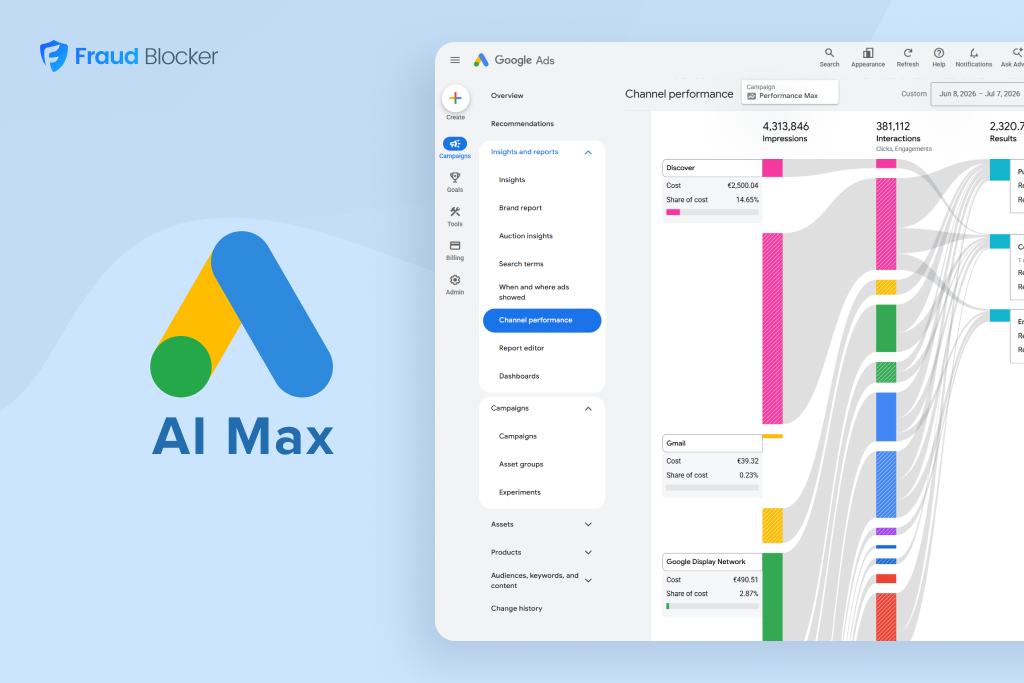
We turned on AI Max for two non-brand Search campaigns and watched daily spend jump by nearly 5x in a matter of days. This new setting found new volume – that part worked well. But it also targeted keywords like “ad blocker”, “web scraper”, and “como crear un bot” (“how to create a bot” in Spanish).
None of these were relevant to our offering, and as since our company focuses on detecting and combating click fraud, it’s not promising that Google’s AI targeted keywords our products were built to catch.
But was this an isolated incident? Or is it a fundamental part of how AI Max actually works? Instead of guessing, we ran a controlled test and scored every query. We found that AI Max trades keyword control for intent matching (a really useful and unique capability), but that is exactly why it can drain your budget faster than anything Google has shipped to Search in years.
In this article we’ll cover what AI Max is, how it works, what our testing uncovered, and how to run it without feeding junk to Smart Bidding.
AI Max is an optimization layer you switch on inside an existing Google Search campaign. It is not a new campaign type, and you are not forced to migrate to it.
Google Ads coach Jyll Saskin Gales, a former Googler who reviews hundreds of accounts a year, has spent months correcting this exact confusion: AI Max isn’t a new campaign type, and the ‘AI Max’ label you see in your search terms report isn’t a real match type either – it’s a tag marking where the traffic came from.
With AI Max on, Google matches your ads to searches based on intent and its own signals rather than your keyword set. It runs only on Google Search text inventory, requires Smart Bidding, and is moving out of Beta and rolling out to advertisers worldwide through 2026.
Note: Starting September 2026, Google plans to auto-upgrade campaigns still using Dynamic Search Ads (DSAs) into AI Max. For a lot of accounts, this means it will be a mandatory campaign upgrade within the year.
AI Max, when turned on, gives you options to enable three features at once. And while none of them are new on their own, Savvy Revenue’s Andrew Lolk describes AI Max as “a hybrid that does three things simultaneously: keyword expansion, ad-copy generation, and URL expansion”.
Below is more detail on each of the main features of AI Max:
This allows for expanded reach beyond your keyword set. AI Max treats your keywords as a starting point and then expands past them, using broad match and intent signals (no keywords needed) to match your ads to queries it predicts will convert. It draws on your landing pages, ad copy, and existing keywords. This is the feature that finds searches you never thought to target, but it’s also the one that causes drift from your keyword targeting.
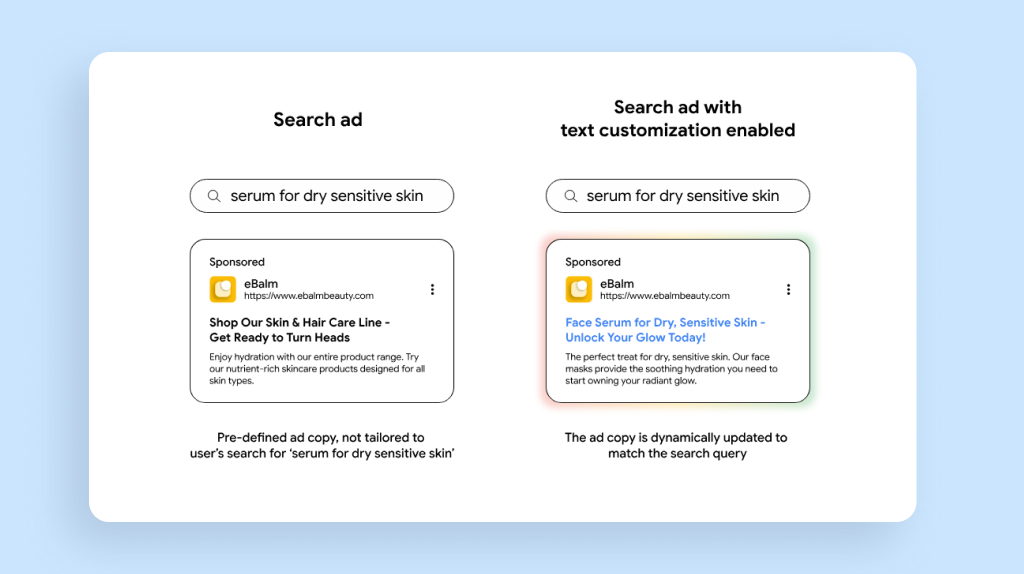
Once AI Max is enabled, this is an extra setting you can turn on or off. With this setting on, Google will generate new headlines and descriptions from your existing assets and landing page copy and, using AI, assemble ad combinations meant to fit each query.
You keep control of the assets you provide and can remove generated ones. There is also an option to provide specific rules or guidance to help the AI stay within your brand guidelines. However, if you’ve ever bid on competitor terms, you can see the risk immediately: an ad generated from a competitor query would have a better chance of going wrong than right. That’s why we think this feature needs strict oversight.
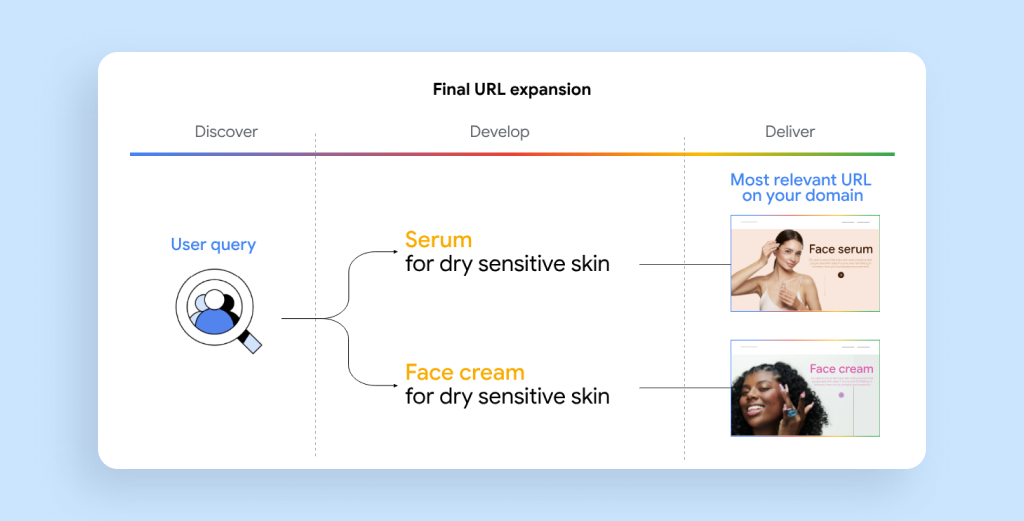
Instead of sending every click to one landing page, Google routes users to the page on your site it judges most relevant to their search. You can exclude URLs. One thing to know before you enable it: with final URL expansion on, asset pinning isn’t respected, so if you pin for legal or compliance reasons, leave this off.
(Images from this article: How AI Max for Search campaigns works – Google Ads Help)
You’ll find it in Campaign settings on any smart bidding search campaign. It’s a single “Optimize your Search campaign with AI Max” toggle.
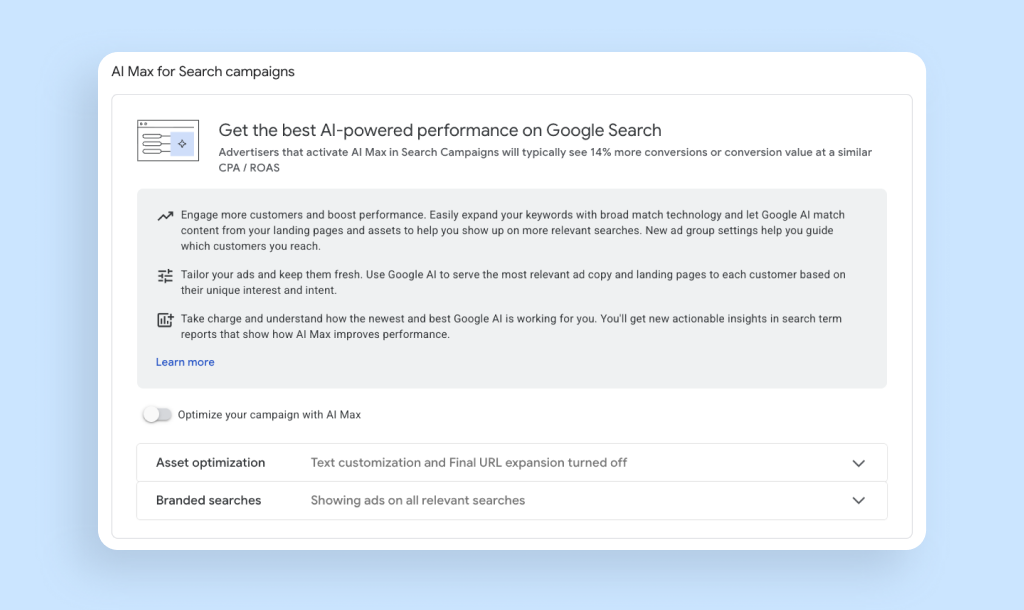
Turning on AI Max enables search term matching and both asset settings (text customization and Final URL expansion) at once, so we recommend knowing the controls before you touch it.

Intent-based matching has a cost: AI Max will serve your ads on searches you never approved or targeted. While that’s one of the major features, it is also where your budget can be spent.
Expanded traffic can skew to generic one and two-word searches and competitor terms if you are not careful, and it may find queries on the account that you would have never chosen.
Ben Heath, an agency owner who has run it across accounts, mentioned the same risk: “AI Max can match irrelevant, low-quality searches to people unlikely to convert.”
The expansion is Google trying to capture demand you’re missing. But “demand you’re missing” and “traffic worth paying for” are not the same thing, and our test showed that the gap between them is where invalid clicks live.
We used AI Max across multiple weeks for two non-brand Search campaigns, then scored every query for relevance to the matched keyword driven by AI Max vs. traditional search queries.
There were 3,372 unique search terms reported, and we reconciled the totals against Google’s own reported numbers.
Key finding: During days when AI Max was turned on, distinct queries jumped over 10x, daily spend increased nearly 4.5x, and 90%+ of that additional spend went to off-target searches (vs. 4% on normal days). While the reach was real, so was the waste.
We also found that much of AI Max’s “expansion” was traffic you’d have won anyway. The other part—the genuinely new queries it opens up—is where the real cost (and wasted spend) hides.
| Match Source | Share of Test-Campaign Spend | Share of Spend with Low Relevance |
|---|---|---|
| Our keywords (exact/phrase/broad) | 25% | 2% |
| AI Max – matched to our keywords | 21% | 98% |
| AI Max – pure expansion (no keyword) | 54% | 94% |
| AI Max (all) | 75% | ~95% |
Source: Fraud Blocker internal data. Sample: Two non-brand Google Search campaigns. Query relevance scored against matched keyword intent.
During our test, AI Max queries made up 75% of spend. It expanded our query footprint and brought in a lot of additional traffic.
But there’s bad news. During the test, our daily spend jumped 4.5x, and account CPA rose 26% (the CPA is a best-case scenario because it’s blended with our other campaigns like Brand, which AI Max never touched and converts at a very low CPA.
We researched studies from top marketing agencies for any test results related to AI Max performance. Their tests found one major theme: a lot of what AI Max calls “new” wasn’t new at all.
While the names sound the same, there are big differences between the two. AI Max keeps you in Search and expands with a few controls; Performance Max spreads across every Google channel with less controls.

 Expand to view chart data
 | AI Max | Performance Max | |
|---|---|---|
| What it is | A setting inside a Search campaign | A separate campaign type |
| Where it runs | Google Search text inventory | Search, Display, YouTube, Gmail, Discover, Maps |
| Query control | Negatives, brand and URL exclusions, search-term reporting | Limited; audience signals, not targeting |
| Reporting | Search terms report with a Source column | More opaque, though improving |
| Requires Smart Bidding | Yes | Yes |
Remember: AI Max gives you more levers to steer the expansion. PMax gives you reach into new channels at the cost of some control and visibility. But neither one will filter invalid traffic.
AI Max is a big setting change that needs guardrails, and we strongly recommend putting the guardrails up before you turn it on.
Optmyzr’s Frederick Vallaeys, one of Google’s first AdWords employees, has made this his consistent message about every automated product Google has shipped:
“Smart Bidding, Performance Max, AI Max; they all work better with control and thoughtful settings alongside them,” he said.
Importantly, if you use URL expansion on AI Max because it relies on your landing pages to decide what to match and where to send traffic, your landing page content carries more weight than it used to.
Here’s the pre-flight checklist:
With the last point, fraud protection can be a truly valuable resource for cleaning up your signals.
Key point: AI Max optimizes toward the conversions it’s fed. If invalid clicks are firing your pixel, you’re not just wasting today’s budget but also training the algorithm to waste tomorrow’s as well.
Fraud Blocker’s Intelligent Detection flags invalid clicks and adds the IPs to your Google Ads exclusion list in near real-time, including on AI-Max-expanded traffic. Cleaner inputs, better learning, less spend on clicks that were never going to convert.
The short answer: not yet, for most accounts. Here are the findings from some of the top minds in PPC and Google Ads:
He recommends Broad Match and Smart Bidding first, then Performance Max. Don’t touch AI Max with search impression share under 60%, because you still have room to grow on terms you already win. He puts it where PMax was in 2022: promising, not yet trustworthy.
Fraud Blocker’s own Co-founder and Chief Growth Officer, Brandon Tome, put it even more bluntly:
“We’ve tested AI Max in-house and found that it’s just not there yet. The expansion either delivers traffic you’d have captured anyway or drives traffic that’s mostly wasted spend. Our spend quadrupled and account CPA rose 26%. We don’t recommend turning on AI Max in its current state.”
To be fair, Google’s headline claim about 14% more conversions at similar CPA or ROAS has real case studies behind it. But AI Max is a high-powered exploration system. Point it at a strong foundation with clean signals and it can find profitable demand. Point it at a thin account with a leaky conversion setup and no click fraud protection, and it spends fast on traffic that doesn’t convert.
The decision isn’t “AI Max: yes or no.” It’s “is my account ready, and is my traffic clean enough to teach it well?”
AI Max’s whole job is to spend into searches you never chose. Used well, that finds demand you were missing. Used without guardrails, it finds traffic that was never going to convert, and because Smart Bidding learns from whatever clicks come through, bad traffic skews what it optimizes toward next.
That’s the real reason to run fraud protection alongside AI Max. Fraud Blocker’s Intelligent Detection, powered by 100+ signals, flags invalid clicks and blocks the IPs behind them on your Google Ads campaigns in near real-time so the data your bidding learns from reflects real customers, not bots and competitors. Turn on AI Max when your account’s ready. Keep its expanded traffic clean from day one.
In our own test, yes, and sharply. Because AI Max matches on intent rather than your keyword list, it serves on queries you never chose, where off-target and invalid traffic concentrates.
When we toggled it on across our non-brand Search campaigns, 85% of the spend went to off-target queries (vs. 4% on normal days), and blended AI Max CPA ran about 8× our keyword campaigns. The fix is controls plus fraud protection, not avoiding AI Max outright.
Use Google’s AI Max Experiment (a within-campaign traffic split) or a pre/post comparison. Run it at least four weeks past the learning period, hold budgets and targets steady, and judge it on conversions, CPA/ROAS, and traffic quality together. Don’t judge it on click volume, which will always rise.
Commit for at least two months; if you kill it too early, the learning spend is wasted. And if you’re migrating off Dynamic Search Ads, pause DSA first: running both, Savvy Revenue saw AI Max barely activate (72 of 3,000+ clicks) until DSA was off.
Often not yet. It rewards accounts that already run broad match with Smart Bidding and have conversion volume and budget headroom. If you’re tight on budget in a high-CPC, high-fraud vertical, set your controls and fraud protection first, or AI Max can spend quickly on traffic that never converts.
Negative keyword lists, brand exclusions and inclusions, URL exclusions, the ad-group search-term-matching controls, and clean conversion tracking. Then review the search terms report by Source weekly to catch drift early.
Note: We have many of these in the “Performance Booster” section of our app.
AI Max. It stays inside your Search campaign with brand, URL, and location controls and clearer reporting. Performance Max is a separate campaign type spanning all Google channels with less query-level control.

ABOUT THE AUTHOR
Brandon is the co-founder and Chief Growth Officer at Fraud Blocker with 15+ years of performance marketing experience and $100M in direct ad spend management. He specializes in driving growth and maximizing ROAS across B2B SaaS, fintech, marketplaces and more.
Brandon is the co-founder and CGO at Fraud Blocker with 15+ years of performance marketing experience. He specializes in driving growth and maximizing ROAS across B2B SaaS, fintech, marketplaces and more.