

Performance Max Pros and Cons in 2027: What Google Fixed and What Advertisers Still Need to Control
Performance Max has improved a lot since 2023. See what Google fixed, what still needs your attention, and how to run PMax effectively in 2027.



Our AI agents catch the sophisticated fraud others miss and it tells you why. Learn more here.



Click fraud is costing advertisers billions in loses. Learn more here.

Click fraud is costing advertisers billions in loses. Learn more here.


Read our in-depth study by independent research firm Juniper Research.



 Key Takeaways
 Every year, advertisers spend Billions on Google ads (264.5 Billion in 2024 alone according to Statista. But for most, the question of “how much does Google ads cost?” doesn’t have a single answer. That’s partly because it depends on a number of factors, but more importantly, the figure you see on your Google Ads dashboard isn’t the real number.
Our research shows that the real cost of Google ads is 6.4% higher than you think, based on data from 43,701 Google Ads accounts, over 104.9 million clicks and $111.7 million in ad spend.
This 6.4% figure is the result of invalid clicks that slip through Google’s filters.
In this guide, we’ll share how we found this figure, how much advertisers are actually paying in real dollar amounts, and why the costs keep climbing. We’ll also share strategies to keep your ad costs down.
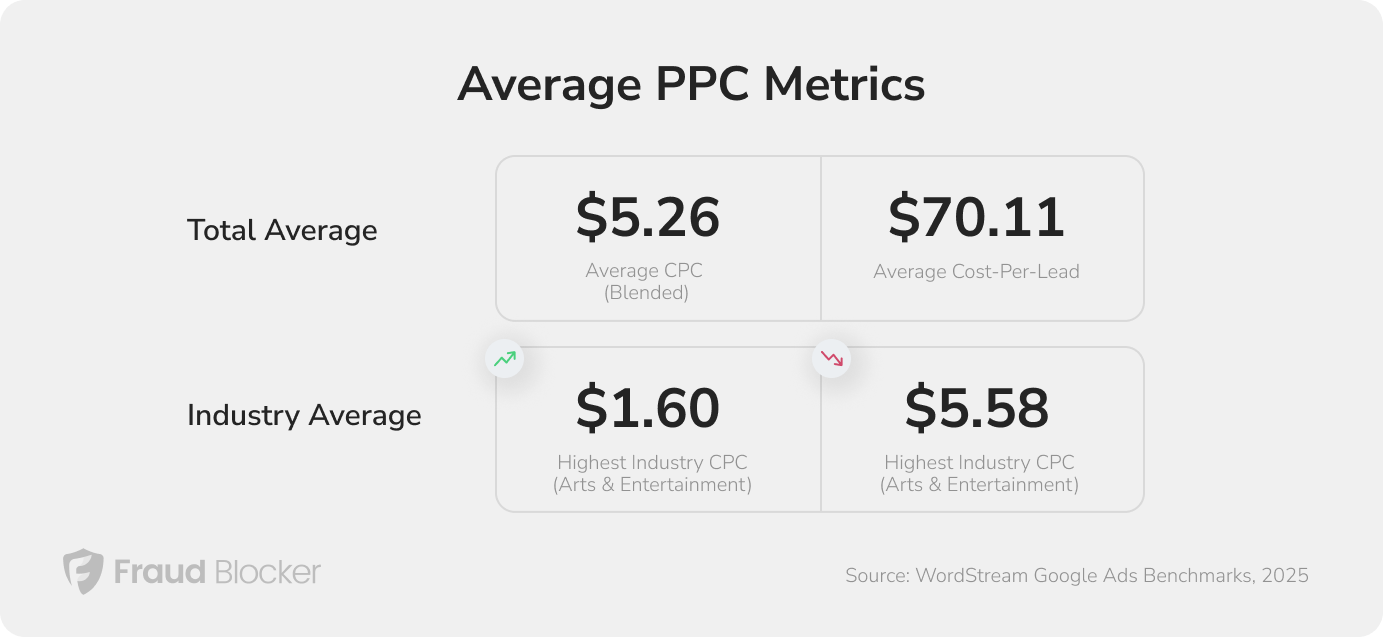
The average cost per click in Google ads in 2025 was $5.26, and the average cost per lead was $70.11. This average extends from small to large industries and covers CPC ranges from $1.60 to $8.58.
Most small to mid-sized businesses spend between $1,000 and $10,000 per month on Google Ads. In highly competitive verticals like legal services, where legal keywords are among the most expensive in Google Ads, monthly spend can be much higher.
Now, these numbers are a sweeping average, and they cut across thousands of industries, campaign types, and geographies. Your actual costs will be very different (and we’ll explain why shortly.)
Here’s a quick snapshot of the key benchmarks:
| METRIC | 2025 AVERAGE |
|---|---|
| Average CPC (Search) | $5.26 |
| Average Cost Per Lead | $70.11 |
| Typical monthly spend (SMBs) | $1,000 - $10,000 |
| Lowest industry CPC | $1.60 (Arts & Entertainment) |
| Highest industry CPC | $8.58 (Attorneys & Legal Services) |
The industries with the highest CPCs were Attorneys & Legal Services at $8.58 followed by Dentists & Dental Services, and Home & Home Improvement at $7.85. On the lower end are industries like Arts & Entertainment at $1.60.
CPCs vary wildly because Google’s auction prices are based on intent and competition. The more a single sale is worth, the more businesses are willing to pay per Google Ad click, and the higher the CPC will be.
Here’s the full breakdown of CPC costs per industry:
| INDUSTRY | AVG. CPC | AVG. COST PER LEAD |
|---|---|---|
| Attorneys & Legal Services | $8.58 | $131.63 |
| Dentists & Dental Services | $7.85 | — |
| Home & Home Improvement | $7.85 | — |
| Education & Instruction | $6.23 | — |
| Finance & Insurance | $3.46 | $83.93 |
| Restaurants & Food | $2.05 | $30.27 |
| Travel | $2.12 | — |
| Arts & Entertainment | $1.60 | $30.27 |
| All Industries (Average) | $5.26 | $70.11 |
The average advertiser loses $163 per account to invalid clicks that Google doesn’t catch and doesn’t refund. That budget is real ad spend, but it never produces a conversion.
Our 2023 study already showed that invalid traffic and ad fraud waste billions annually. New findings suggest that it also increases how much you pay for Google ads.
Fraud Blocker analyzed data from 43,701 Google Ads accounts, examining 104.9 million clicks, 6 Billion impressions, and $111.7 million in ad spend.
We found an average invalid click rate of 17.8% across Google Ads accounts. A sharp increase from the 11.4% invalid click rate reported by Google.
When Google catches invalid clicks, it refunds advertisers for the wasted spend. But, according to our findings, the invalid click rate is 6.4% higher than Google’s reported figure; that’s 6.4% of clicks that Google doesn’t refund you for, and you end up paying for.
To put it in perspective, that means 6.7 million out of 104.9 million clicks were from bots, competitor activity, click farms, and other non-human traffic sources. These consume your budget and will never contribute to conversions.
Across the accounts in our dataset, that invalid traffic represents $7.1 million in wasted ad spend, an average of $163 per account.
The table below shows the true cost of Google ads per industry when you factor in 6.4% invalid clicks.
| INDUSTRY | AVG. CPC | INVALID CLICK RATE (UNREFUNDED) | EFFECTIVE CPC (REAL TRAFFIC ONLY) |
|---|---|---|---|
| Attorneys & Legal Services | $8.58 | 6.40% | $9.17 |
| Dentists & Dental Services | $7.85 | 6.40% | $8.39 |
| Home & Home Improvement | $7.85 | 6.40% | $8.39 |
| Education & Instruction | $6.23 | 6.40% | $6.66 |
| Finance & Insurance | $3.46 | 6.40% | $3.70 |
| Restaurants & Food | $2.05 | 6.40% | $2.19 |
| Travel | $2.12 | 6.40% | $2.26 |
| Arts & Entertainment | $1.60 | 6.40% | $1.71 |
| All Industries (Average) | $5.26 | 6.40% | $5.62 |
Invalid clicks are clicks that don’t represent true user intent. These could be from bots, competitors looking to waste your budget, or accidental clicks from real users. But these clicks will never convert, and so, you’re essentially wasting money on them.
Read more: Everything Advertisers Should Know about Click Fraud? – A complete guide to how click fraud works, the different types, and why it’s costing advertisers billions in wasted ad spend.
According to Wordstream, CPCs in Google Ads increased across 87% of industries in 2025, continuing a multi-year trend of rising costs. But our findings indicate that advertisers aren’t just paying more for clicks. They are also paying a higher percentage based on invalid clicks today than they did 15 years ago.
We found that invalid click rates have nearly doubled over the last 15 years.

Google’s Smart Bidding Algorithms learn from your campaign’s performance data, optimizing which clicks convert and adjusting bidding accordingly. But that’s a problem when a portion of your clicks are coming from fake users that don’t convert.
The algorithm reads these invalid clicks as poor targeting, and then adjusts your bids upward to find converting traffic.
Besides wasting the budget they consume, invalid clicks also feed bad data into Google’s Smart Bidding algorithms, which then raise your bids to compensate for the low conversion rate caused by bad traffic.
Our earlier cited 2023 study also showed that location affects invalid clicks on your account as much as it affects your CPCs.
We found that ad fraud activity is concentrated most heavily in two regions:
Together, these two regions account for nearly two-thirds of projected fraud impact worldwide, consistent with what we see within Google Ads specifically.
Google’s Ad auctions determine what you pay for ads, and it runs every time a user searches for a term you’re bidding on. Each ad is assigned an Ad rank which weights the maximum bid and the Quality Score, and these determine what gets shown.
Other factors also influence your CPCs, like:
Increasing CPCs are caused by factors advertisers can’t control (rising competition, inflation, shrinking ad supply, and even changes to how Google ad auctions works).
But, there are still two major ways to lower your Google Ads costs:

Our analysis of 43,701 Google Ads accounts found that the true invalid click rate is 17.8%, 6.4 percentage points above what Google reports and refunds. That gap costs the average advertiser $163 per account in unrecovered wasted spend (some much more). It also increases the average cost per click from $5.26 to $5.62 across all industries.
If you’re in a high-CPC vertical like legal and dental, you’ll likely pay even more.
Understanding the true cost of your Google Ads is the first step to lowering your costs and optimizing your campaigns, and ensuring your spend actually reaches real users.
You can try Fraud Blocker’s click protection software for 7 days and see how much you can save on your CPCs.
Most small to medium-sized businesses spend between $1,000 and $10,000 per month. But businesses in highly competitive industries like legal services or home improvement tend to spend much more. Your actual monthly cost depends on your industry’s average CPC, your daily budget, and the keywords you are targeting.
CPCs in Google Ads have risen across 87% of industries for five consecutive years, and the increase is driven largely by greater competition for limited ad space. This is primarily driven by increased competition for limited ad placements, inflation’s impact on advertiser budgets, and the growing role of automated bidding strategies (like PMax and AI Max) that can push bids higher. Fraud Blocker’s research also shows that invalid traffic inflates your effective cost per genuine click beyond what your dashboard reports.
Legal services ($8.58), dental ($7.85), and home improvement ($7.85) are the most expensive. High customer lifetime value in these sectors drives aggressive bidding, pushing auction prices up across the board.
To lower your Google Ads CPCs, improve your Quality Score, tighten keyword targeting, add negative keywords, and review placement reports regularly. Reducing invalid clicks through IP and geo exclusions can also help lower your effective cost per real click.

ABOUT THE AUTHOR
Matthew is the resident content marketing expert at Fraud Blocker with several years of experience writing about ad fraud. When he’s not producing killer content, you can find him working out or walking his dogs.
Matthew is the resident content marketing expert at Fraud Blocker with several years of experience writing about ad fraud.