


How Much Does Google Ads Cost? (Hidden Costs for Advertisers)
Average Google Ads CPC is $5.26, but our research shows advertisers are actually paying $5.62 due to invalid activity. Here's…


We improve your ad performance by blocking click fraud and fake emails



Click fraud is costing advertisers billions in loses. Learn more here.

Click fraud is costing advertisers billions in loses. Learn more here.



Read our in-depth study by independent research firm Juniper Research.



 Key Takeaways
 At Fraud Blocker, we monitor an enormous amount of data that gives us an advantage to tracking click fraud. Our platform analyzes over 60 million unique IP addresses every month across more than 4,500 domain names.
For this study, we conducted an in-depth analysis of 200 million individual ad clicks, utilizing our BigQuery warehouse and our Google Ads API to take a close look at the data across our entire network.

Our analysis was designed to share specific, technical signatures of click fraud that advertisers are likely paying for. By looking at the raw log-level data, we’ve identified patterns that confirm click fraud is no longer a fringe nuisance but a sophisticated, industrial-scale challenge that directly impacts advertising ROI.
Click fraud is the practice of repeatedly clicking on pay-per-click (PPC) advertisements to generate fraudulent revenue for a host website or to drain a competitor’s budget. It is no longer just a “bot problem” or a few teenagers in a basement, it is a multi-layered, global industry (read more about click fraud)
There are a few primary motivations behind the billions of fraudulent clicks occurring daily:
In 2026, the cost of ad fraud is projected to exceed $100 billion. For the average advertiser, roughly 22% of all digital ad spend is lost to invalid traffic.
If you’re spending $10,000 a month, you are essentially writing a $2,200 check every month to a fraudster who will never buy your product.
Even worse, this illegitimate data feeds back into your AI-optimized bidding (like Google’s Performance Max or Meta’s Advantage+), training the algorithm to find more bots because it thinks they are high-quality visitors. This creates a “death spiral” where your cost-per-acquisition (CPA) stays high while your actual revenue plateaus.
Physical geography is often a dead giveaway in fraud detection.
In our 3-day analysis window, we tracked thousands of devices that appeared to be traveling the globe at impossible speeds.
Modern fraud has moved away from easily identifiable data center IPs (like AWS or DigitalOcean) and has transitioned into Residential Proxy Networks. By routing bot traffic through the IP addresses of real households, often compromised IoT devices or users of “free” VPNs, fraudsters make their traffic appear as legitimate domestic users.
The top offender in our analysis appeared in 87 unique countries in under 72 hours 😱. This is an undeniable signal of programmatic manipulation. These devices often appear in multiple distant regions, such as the United Kingdom and Brazil, within the same 60-minute window. There is no legitimate scenario where a single device ID authentically represents a traveler visiting 87 countries in a single weekend.
This proves that high-speed automated systems are rotating through global proxy pools to bypass geo-targeting filters and reach high-CPC (Cost-Per-Click) markets like the United States and Western Europe.

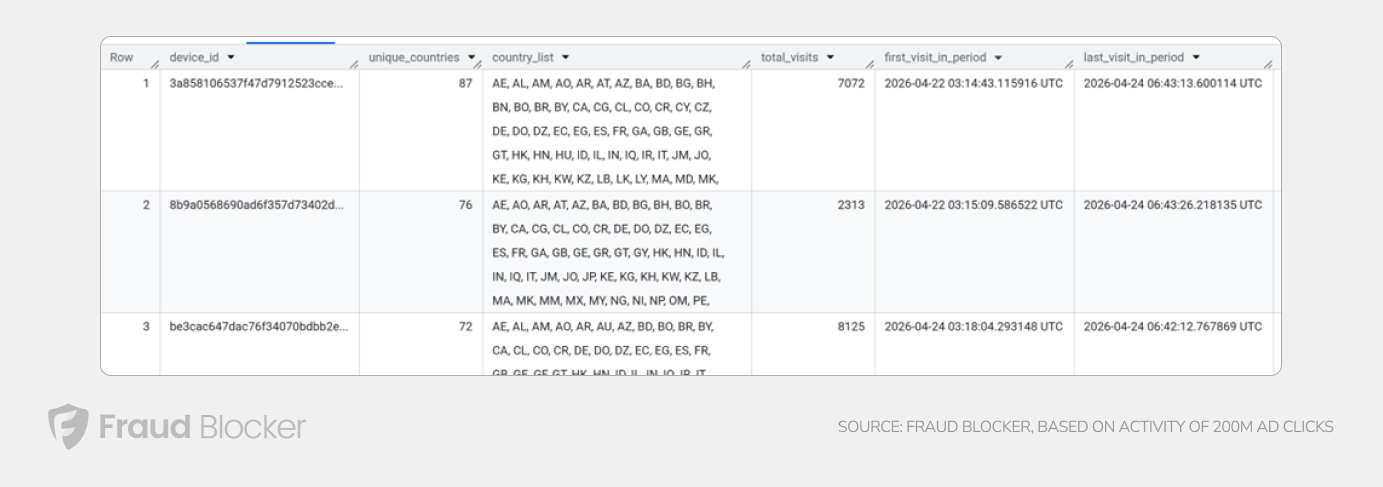
There is virtually no legitimate scenario where a single device ID would authentically represent a user traveling between 60+ countries in 72 hours.
We have identified several thousand visits where the User Agent string was intentionally manipulated to hide the actual operating system or the use of automated “Headless” browsers.
These mismatches are strong indicators of automated scripts (like Selenium or Puppeteer) attempting to masquerade as human-operated desktop computers.
Here are a few examples of what we detected:
Here’s an example of Fingerprint Spoofing:

Sample of this data from our BigQuery results:

Technical mismatches between a browser’s self-declaration and its physical fingerprint almost never occur in legitimate user scenarios. These are deliberate attempts to bypass security filters.
The most striking evidence of fraud is the presence of several devices exhibiting visit rates that are physically impossible for human users.
Our analysis identified several device IDs with visit rates that represent a massive automated bot network. The most striking example was a single Device ID (aed4a5…) that recorded nearly 5 million visits over a 3-day period.
For comparison, for a human to generate 5 million visits in 72 hours, they would have to refresh a landing page approximately 1,150 times every minute without pause. This behavior is characteristic of “High-Frequency Polling,” where a script is programmed to hit an ad-spend-generating link as quickly as the server will respond.
What makes this particular offender credible as a “sophisticated” actor is its use of IP rotation. During those three days, the device also cycled through 497 unique IP addresses. This is a bot leveraging a distributed network to evade simple “rate limiting” rules that only look for too many clicks from a single IP.
Here’s a sample of data from the top 10 most active devices:

This combination of high-frequency polling and IP rotation is characteristic of scraping bots or large-scale click farms.
Perhaps the most damaging discovery in our 200 million click set is the prevalence of Click Recycling.
In a healthy ecosystem, a “gclid” (Google Click Identifier) is a unique string that creates a 1-to-1 link between a specific ad click and a website visit.
However, we found evidence that bot operators are “harvesting” legitimate gclids, likely through session recording or intermediate “landing page” farms, and then reapplying them to thousands of automated visits.
This behavior suggests that bot operators are capturing legitimate gclids (perhaps through session recording or intermediate “landing page” farms) and then reapplying them to thousands of automated visits to make that traffic appear to be the result of a paid conversion.
Examples we found:
We summarized the worst offenders in the scatter plot chart below. This shows that ad click IDs are being “recycled” across vast numbers of unique devices and network locations:
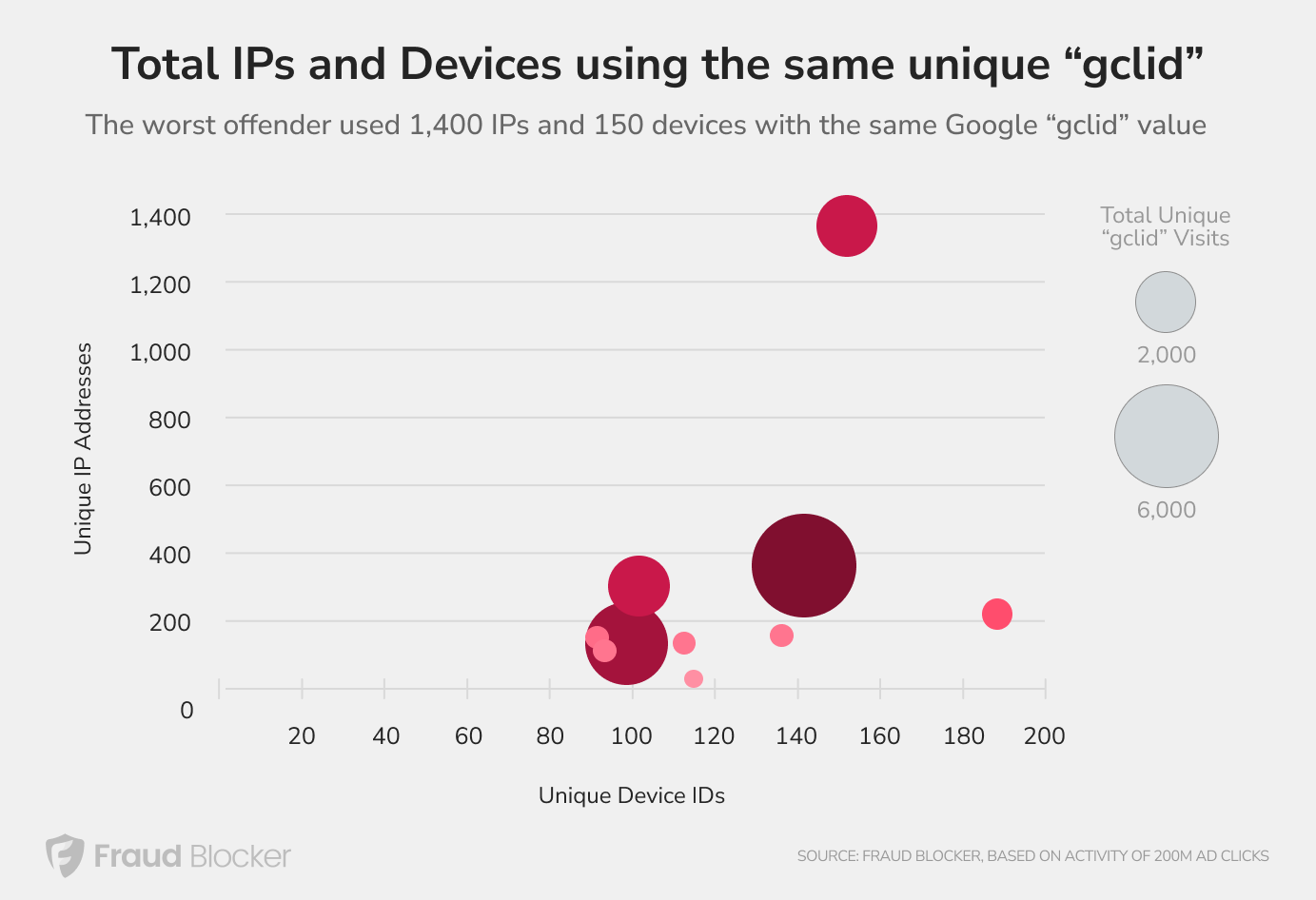
Sample of this data from our BigQuery results:

A gclid is intended to be a unique identifier for a specific ad interaction. Any instance of one being shared across more than 2-3 unique devices or network locations is an almost certain indicator of programmatic manipulation.
The patterns uncovered in this 200 million click analysis include the impossible location jumping between 80+ countries, device spoofing, global proxy rotations and technical masquerading. They all point to clear proof that click fraud is part of sophisticated “Fraud-as-a-Service” infrastructure.
Standard platform protections are often designed to catch the “low-hanging fruit” of basic bots. However, the sophisticated invalid traffic we have detailed here requires a dedicated, real-time layer of defense that looks beyond the IP address and into the hardware-level behavior of every visitor.
These insights are just a small sample of what we’ve uncovered and we’ll share much more soon.

At Fraud Blocker, our mission is to restore integrity to your advertising data by identifying and blocking these sophisticated bots before they drain your budget.
By analyzing over 50 technical signals for every click, we provide a defense layer that standard platforms simply aren’t built to maintain. On average, our clients see a significant reduction in invalid traffic, allowing them to save up to 20% on wasted ad spend.
When you eliminate the “garbage data” from your campaigns, your AI bidding models begin to learn from real human interactions, your CPA drops, and your true ROI becomes clear.
The data from 200 million clicks proves that fraud is happening every day, the question is whether you are willing to continue paying for it.
Methodology
† Fraud Blocker conducted a large-scale quantitative analysis of 200 million individual ad clicks aggregated from our proprietary monitoring platform of 60 million monthly unique IP addresses and approximately 4,500 domains. Utilizing our BigQuery data warehouse and Google Ads API, we used AI-powered data mining to help identify sophisticated patterns of manipulation that often bypass standard platform protections.
[This post was authored by Fraud Blocker’s Founder and CEO, Mike Schrobo]

