



[Exclusive] How Your Recycled Phone is Powering the Latest Click Farms
Our team gained rare access to click farms in Vietnam where we photographed "box phone farms" powering a new scale of fake engagement.



Our AI agents catch the sophisticated fraud others miss and it tells you why. Learn more here.



Click fraud is costing advertisers billions in loses. Learn more here.

Click fraud is costing advertisers billions in loses. Learn more here.



Read our in-depth study by independent research firm Juniper Research.



 Key Takeaways
 The Legal industry is historically one of the most expensive verticals in paid search (top 5, from our data). We found that US legal advertisers on average pay $10 per Google Search click – several multiples higher than what e-commerce, travel, or SaaS advertisers pay for traffic in their own categories. In the most competitive practice-area keywords, individual clicks can run past $600.
That high cost and competition is the reason click fraud hits legal harder than almost any other industry. Every fraudulent click costs more here than it would anywhere else. And, as we’ll see, more of them slip past Google’s invalid click filters than most legal advertisers realize.
For this report, we analyzed data from Q1 2026, across 50+ US legal Google Ads accounts, more than 450K clicks, and $720K in ad spend. We look at why the structural conditions in legal make this gap more significant than in other verticals, where the invalid clicks actually concentrate (not where most advertisers look), and what you can do about it.
Click fraud exists in every industry that runs paid search. But most high-spend verticals like e-commerce‚ travel‚ and SaaS can spread their budgets across large populations and dozens of geographies. Legal advertisers don’t have that luxury․
If you are a personal injury attorney in Houston, you’re competing against other Houston firms, usually targeting the same zip codes‚ bidding on the same keywords‚ and hoping to reach a future client exactly when they need you; for example, when searching for help after a car accident․
That’s a big reason law firms come under attack: fraudsters and competitors don’t need a crystal ball to know where the good clicks are․ A bad actor with an automated script could easily burn through a small firm’s daily budget on “car accident lawyer near me” in a single metro area before lunch․ And with US legal search CPCs averaging $10 (and some keywords exceeding $600 each!) wasted clicks on these ads are painfully expensive compared to almost any other listing on Google Ads․
Legal advertisers usually pay more for traffic and lose more to fraud than advertisers in lower cost verticals․ As we’ll see, those cost add up and most of them never show up in your invalid click report.
We analyzed a sample of legal Google Ads accounts to put numbers to the problem. Advertisers in our study saw a 14.7% average invalid click rate as identified by Fraud Blocker.
 Expand to view chart data
 | METRIC | INVALID CLICK RATE |
|---|---|
| Google's reported invalid click rate (all Google Ads campaign types, US, legal) | 10.9% |
| Fraud Blocker's detected invalid click rate (same accounts) | 14.7% |
| Difference | 3.8% (35% more than Google reported) |
Source: Fraud Blocker internal data, Q1 2026. Sample: 50+ US legal Google Ads accounts.
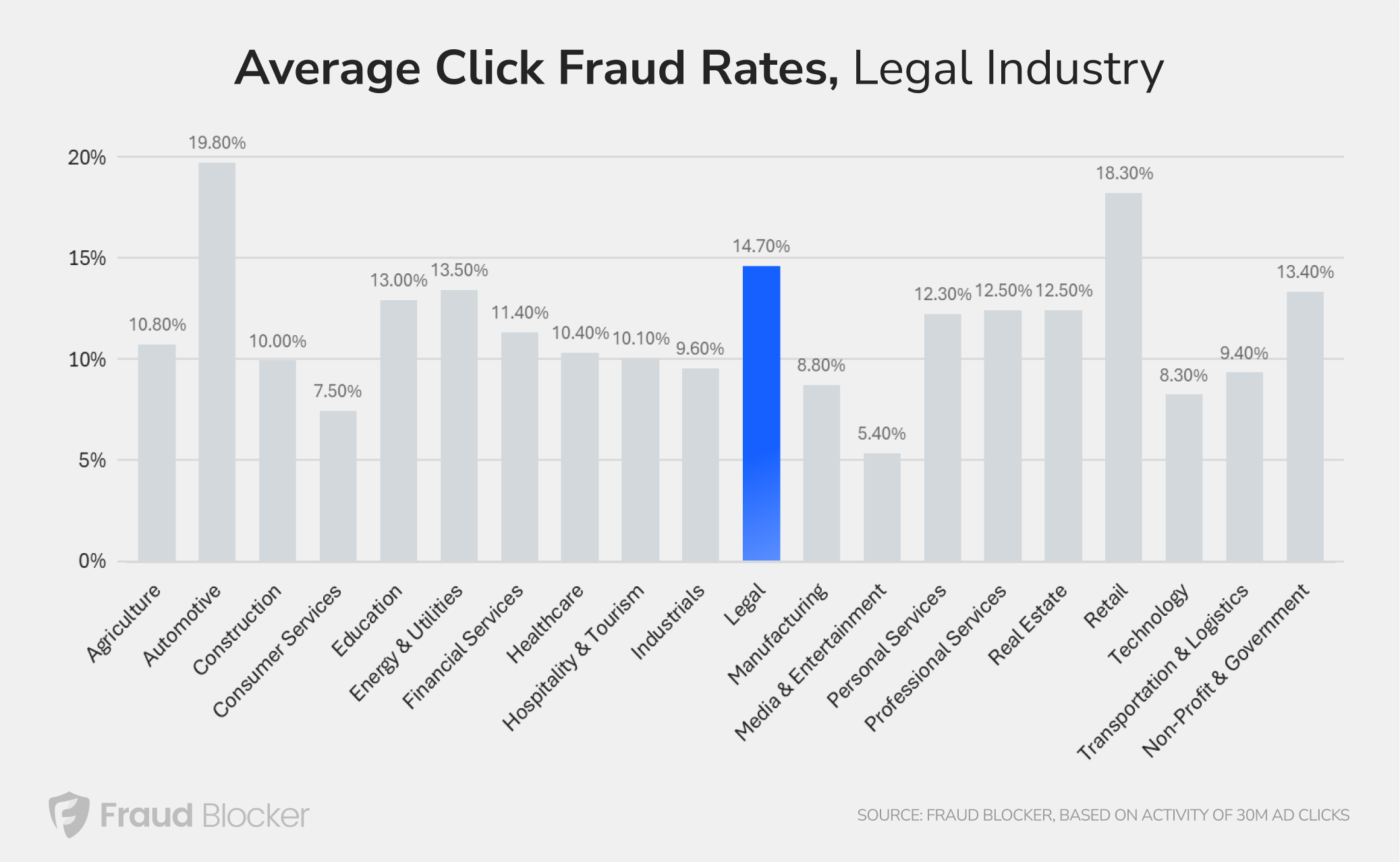
For the same set of legal Google Ads accounts, Google’s average invalid click rate was 10.9%. These are clicks flagged and refunded by Google.
The difference, 3.8% of clicks, is the amount of excess invalid clicks that did not see real human interaction or will never convert to real customers. While the amount is seemingly small, it is roughly 35% more than what Google reported. Put another way: for every three invalid clicks Google’s filters caught, roughly one slipped past.
We found Google’s filters are genuinely good at catching obvious patterns – which is why their invalid click rate is closer 11% and not zero. But for more sophisticated cases (residential proxy traffic that looks like a real US user, clicks from rotating IPs, AI-powered ad fraud), invalid clicks slip through, and that’s the portion you pay for but don’t always see in your reports.
READ MORE: Invalid Click Rate Benchmarks for Google Ads
See how legal compares to real estate, finance, education, and home services across the full Fraud Blocker benchmark data.
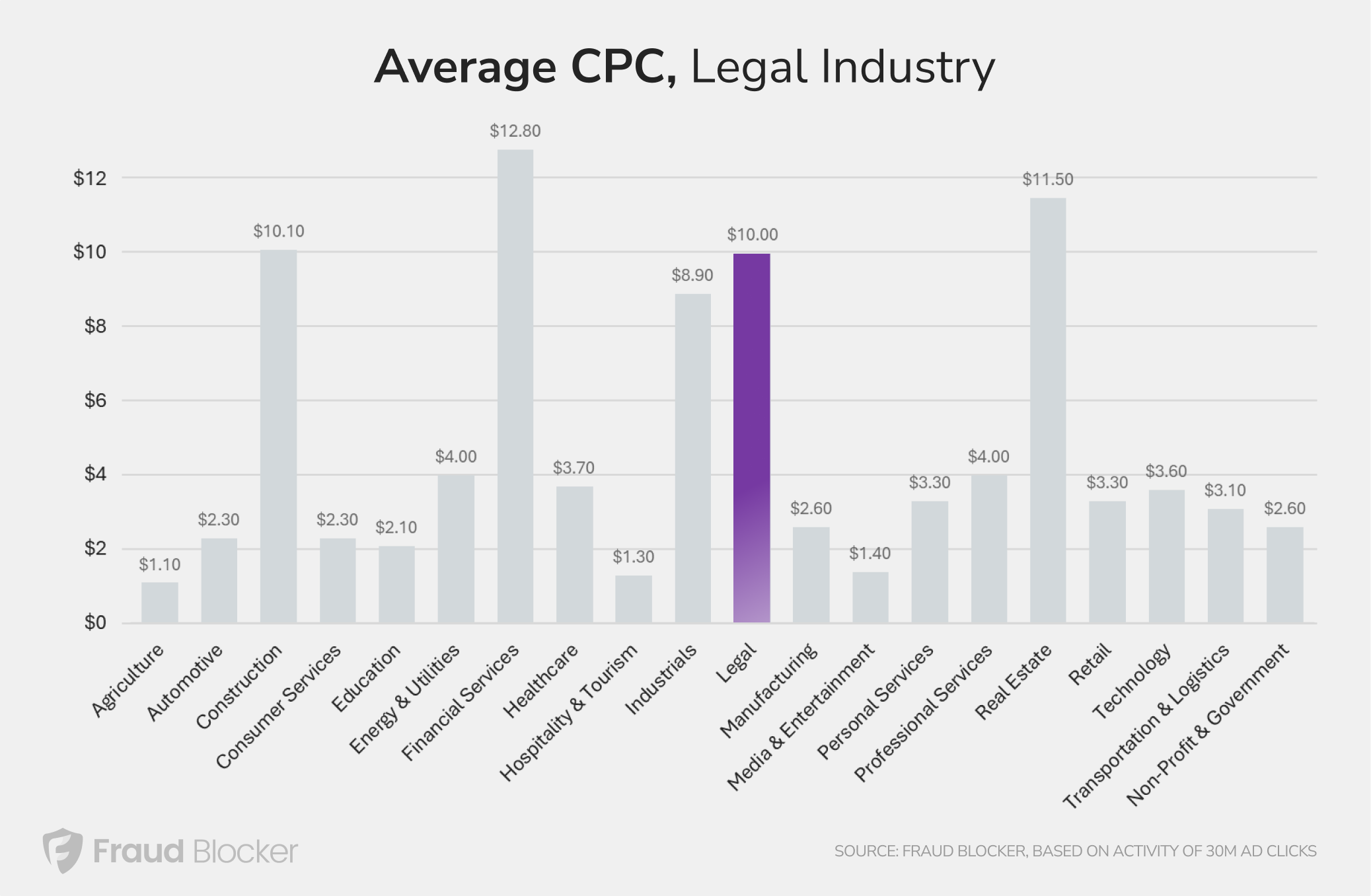
Before we look at the numbers, a quick word on scope. The data below is from over $650,000 in monitored legal Google Search spend across 11 countries in Q1 2026, with US legal advertisers paying the highest CPCs in the dataset (averaging $10 per click, compared to a global legal average of $5.04).
See how legal CPCs compare to other industries below:
 Expand to view chart data
 | METRIC | VALUE |
|---|---|
| Average CPC | $10.00 |
| Clicks analyzed | 36,000+ |
| Total ad spend analyzed | $366K |
| Channels covered | Search |
| Account type | Legal Advertisers, US |
Source: Fraud Blocker internal data, April 2025 - March 2026.
With such a high industry CPC, every click counts – and it is more important for legal advertisers than in almost any other vertical.
To estimate impact, we take the 3.8% difference in invalid activity, and multiply against your budget. Below are a few examples of different practice sizes:
| YOUR SCENARIO | ANNUAL GOOGLE ADS SPEND | ANNUAL INVALID CLICK DIFFERENCE (3.8%) |
|---|---|---|
| Solo practice ($5K/mo) | $60,000 | $2,280 |
| Small firm ($10K/mo) | $120,000 | $4,560 |
| Mid-size firm ($25K/mo) | $300,000 | $11,400 |
| Large firm ($50K/mo) | $600,000 | $22,800 |
| Agency managing 10 legal clients @ $10K/mo | $1,200,000 | $45,600 |
| Agency managing 20 legal clients @ $10K/mo | $2,400,000 | $91,200 |
Derived from the 3.8% gap rate applied to stated annual Google Ads spend. Source: Fraud Blocker internal data, Q1 2026.
The numbers above works whether your CPCs are $3 for estate planning clicks, or $100+ for personal injury keywords. The loss is proportional to your budget, not your keyword mix.
And at an average of $10.00 per click, legal advertisers are losing approximately 38 cents per click. With the most expensive legal keywords, the losses are even larger.
While the flat-rate math shown above is compelling, it understates what the gap costs on your most expensive keywords.
On high CPC keywords like “personal injury lawyers,” legal advertisers are losing up to $23 per click. Here’s the breakdown:
Expand to view chart data | KEYWORD | CPC | INVALID CLICK RATE | LOSS PER CLICK |
|---|---|---|---|
| Oilfield injury lawyers | $620.00 | 3.8% | $23.56 |
| Tractor trailer accident law firm | $500.00 | 3.8% | $19.00 |
| Tractor trailer accident attorney near me | $366.10 | 3.8% | $13.91 |
| Bus accident law firms | $329.96 | 3.8% | $12.54 |
Source: Fraud Blocker internal data.

As discussed above, wasted ad spend on clicks that aren’t from real, human buyers with authentic buying behavior is the top reason advertisers should consider. At a budget of $10k a month or $120k a year, that’s over $5k lost to click fraud every single year. That’s spend that could be invested in more clicks, or even other aspects of your business.
Inflated click counts without any real intent behind them distort your CTR, conversion rates, and CPC metrics. These are metrics advertisers traditionally rely on to make campaign decisions. If your data is corrupted, every bidding and spending decision you make is misguided and likely to waste even more of your budget
Google’s automated bidding strategies learn from your campaign’s conversion data. When a good portion of your clicks are fraudulent and don’t convert, the algorithm sees this low conversion as a signal that your targeting or bids need adjustment. It then increases bids on other terms to find converting traffic.
For an account with high CPCs, the loop nudges costs even higher on adjacent terms to compensate for traffic that was never going to convert in the first place. In this way, the waste keeps compounding.
The more invalid clicks on your campaigns that don’t convert, the lower your conversion rates get. With lower conversion rates:
All these problems will impact future success, and they ripple from invalid clicks.
The goal is rarely to bankrupt a rival. Instead, they are trying to burn through a daily budget before the morning rush of search activity. By the time a real prospective client searches at 9 a.m., the rival’s ad isn’t running. This lost opportunity never appears in any report, which is what makes it hard to fight without something monitoring traffic in real time.
If you are an agency running Google Ads across multiple legal clients, a 4.33% gap at the account level seems subtle at first. Each client’s invalid click rate is slightly different based on practice area, geography, and keyword mix. But the account-level average is consistent enough across our sample that flagging any client running meaningfully above 16.23% detected is a useful first-pass audit threshold.
In an MCC, the gaps per-account compound the larger you get. An agency with 10 legal clients at an average $10,000 monthly spend is managing about $4,300 per month in unrefunded click fraud exposure across the book.
That is budget that could’ve been reallocated to higher performing ads, or used for testing new ad formats. Having visibility into invalid activity at the MCC is the difference between an agency that defends its legal clients’ budgets, and one that absorbs the losses as untracked waste.

If your legal campaigns look anything like the 50+ accounts in our dataset, about 3.8% of your monthly Google Ads spend is going to clicks that never had a chance of becoming clients. That’s roughly $4,560 a year on a $10K monthly budget – that never refunded.
Preventing these losses can be done with manual tactics like IP exclusions and geo exclusions, dayparting, and even keyword exclusions. But they are reactionary; you can only add them after invalid clicks have been identified.
Fraud Blocker closes the gap on wasted clicks, monitoring your ad campaigns in real time, and automatically detecting and blocking invalid traffic sources before they consume your spend. Across the legal accounts in our dataset, advertisers using active fraud protection recovered meaningful budget that would otherwise have gone unrefunded. That’s budget you could be spending on reaching real customers today.
Our report shows what legal advertisers are losing to invalid clicks on average. But you can find out what your campaigns are losing specifically, and more importantly, recover that lost spend.
Start a free 7-day trial. No commitment required.
Invalid click rate is the percentage of total clicks identified as fraudulent or non-human. It is determined based on factors like IP reputation and click patterns, and is calculated by dividing invalid clicks by total clicks, then multiplying by 100.
No. Google only refunds the invalid clicks its own filters catch. Our data shows that Google’s filters miss about 3.8% of invalid clicks, and legal advertisers end up paying for these.
Based on Fraud Blocker’s analysis, legal campaigns average an invalid click rate of 14.7%, although Google only reports an average invalid click rate of 10.9%. This makes legal one of the most fraud-exposed verticals on Google Ads.
On a dollar-for-dollar basis, yes. Legal keywords have high CPCs (average $10.50, with top keywords exceeding $600), so even a 4.33% difference in invalid click rate leads to big budget inefficiencies per account. On a $10,000 monthly budget, the average legal advertiser loses about $433 a month (around $5,196 a year) to clicks Google does not refund.

ABOUT THE AUTHOR
Brandon is the co-founder and Chief Growth Officer at Fraud Blocker with 15+ years of performance marketing experience and $100M in direct ad spend management. He specializes in driving growth and maximizing ROAS across B2B SaaS, fintech, marketplaces and more.
Brandon is the co-founder and CGO at Fraud Blocker with 15+ years of performance marketing experience. He specializes in driving growth and maximizing ROAS across B2B SaaS, fintech, marketplaces and more.
SHARE
INFO
 Source:
Fraud Blocker
 Date:
Date:
 Methodology:
Data is based on an analysis of more than 48 million Google Ads clicks across 23,000+ campaigns in 60+ countries during Q1 2026, representing $42.5 million in monitored ad spend ($170 million annualized).
The legal subset analyzed in this report covers 300+ legal campaigns across 50+ advertisers, with Google Search clicks and $720K+ in legal ad spend during the same period. All data is anonymized and aggregated at the campaign level.