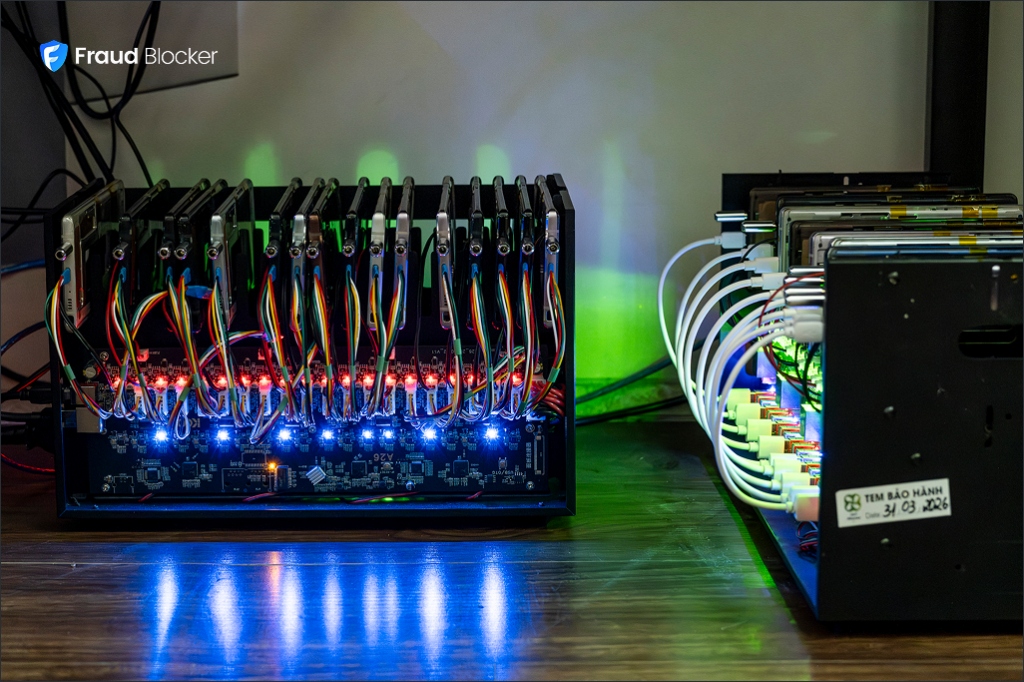



[Exclusive] How Your Recycled Phone is Powering the Latest Click Farms
Our team gained rare access to click farms in Vietnam where we photographed "box phone farms" powering a new scale of fake engagement.


We improve your ad performance by blocking click fraud and fake emails



Click fraud is costing advertisers billions in loses. Learn more here.

Click fraud is costing advertisers billions in loses. Learn more here.



Read our in-depth study by independent research firm Juniper Research.



 Key Takeaways
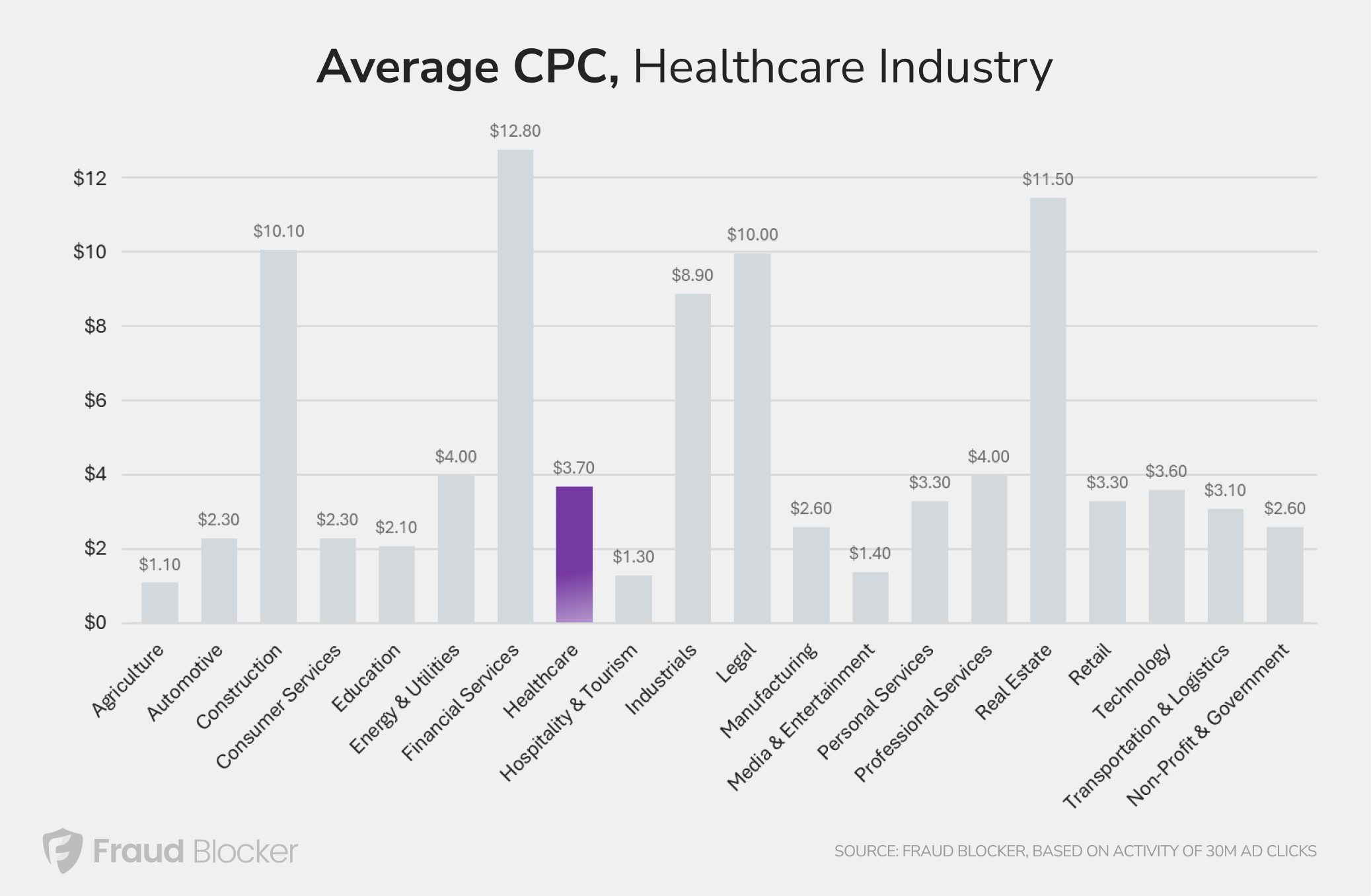
 At $3.70 per click, healthcare advertisers don’t pay the highest CPCs in paid search. But, they buy a lot of clicks and run always-on campaigns month after month. At this volume, even a small percentage of invalid traffic can quickly become a budget problem.
Our data shows just how big that budget problem can become, and it scales with your spend and size of campaigns. We analyzed data from Q1 2026 across 200+ global healthcare Google Ads accounts, more than 3 million clicks, and $3.9M in ad spend.
Our findings are detailed below. In addition to the benchmark figures, we also share why click fraud is a persistent problem for healthcare advertisers, the financial impact in actual dollar amounts, and what advertisers can do to protect their budget.
Click fraud exists in every industry that runs paid search. But healthcare advertisers are particularly at risk because of their continuously running ads. There are three reasons for this:
Read more: What is click fraud?
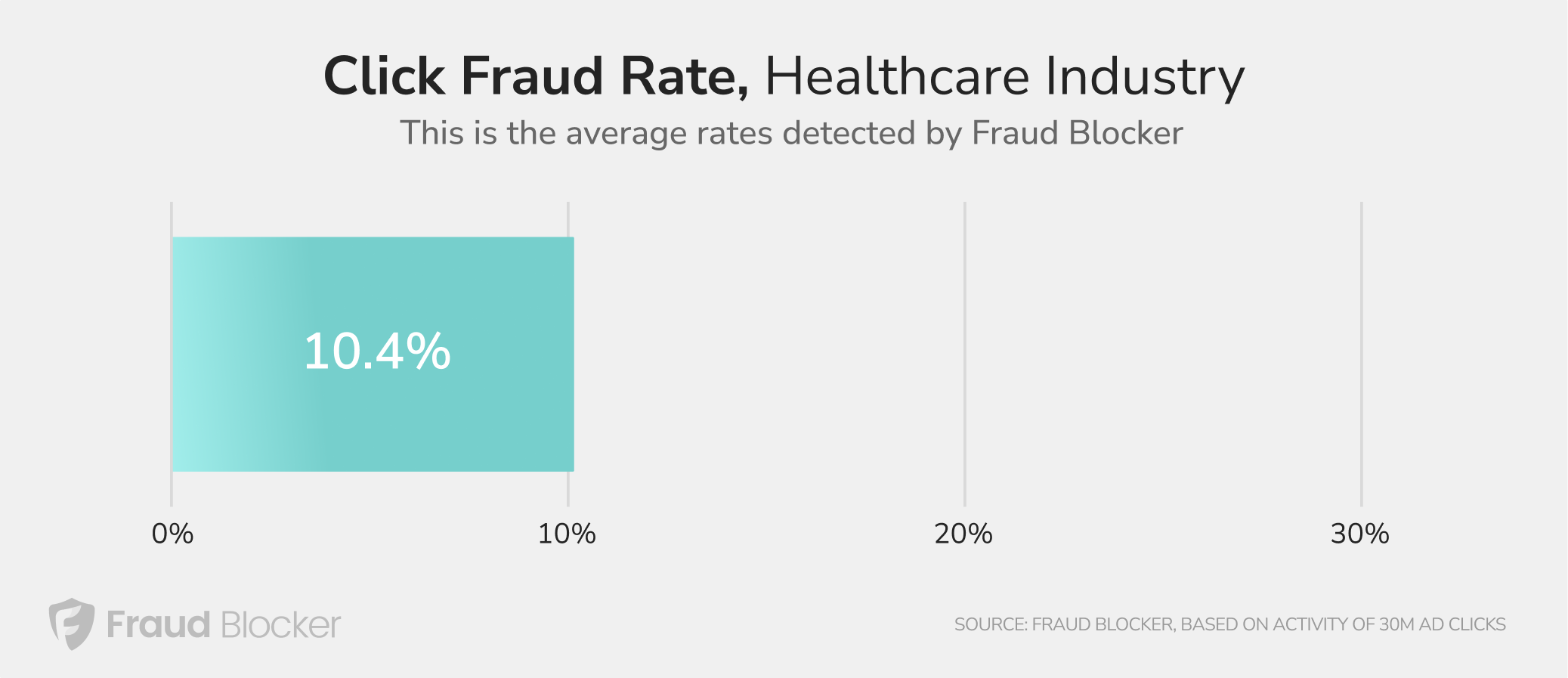
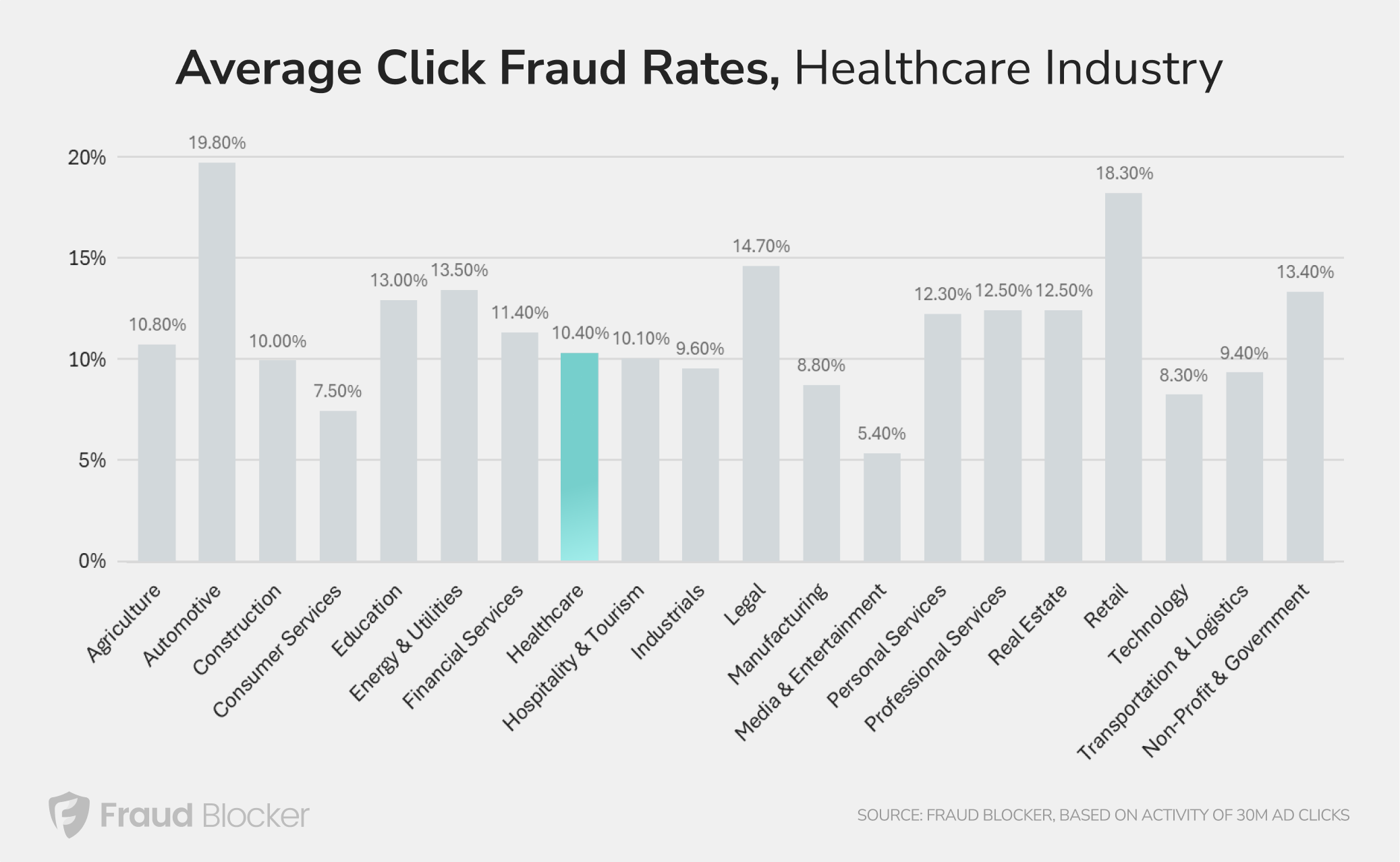
Advertisers in our study saw a 10.4% average invalid click rate as identified by Fraud Blocker.
 Expand to view chart data
 | METRIC | INVALID CLICK RATE |
|---|---|
| Google's reported invalid click rate (global healthcare accounts) | 8.1% |
| Fraud Blocker's detected invalid click rate (same accounts) | 10.4% |
| Difference | 2.3% (28% more than Google reported) |
Source: Fraud Blocker internal data, Q1 2026. Sample: 200+ global healthcare Google Ads accounts.
For the same set of healthcare Google Ads accounts, Google’s average invalid click rate was 8.1%. These are clicks flagged and refunded by Google.
The difference between these two, 2.3% of clicks, are invalid, will never lead to a real conversion, and are not refunded by Google. They are essentially wasted.
That means that for every four invalid clicks Google’s filters caught, roughly one slipped past.
And because healthcare campaigns run continuously year-round, the 2.3% lost will accumulate month over month into substantial wasted spend.
 Expand to view chart data
 | METRIC | VALUE |
|---|---|
| Average CPC | $3.70 (US) |
| Clicks analyzed | 200,000+ |
| Total ad spend analyzed | $749k |
| Channels covered | Search |
| Account type | Healthcare Advertisers, US |
Source: Fraud Blocker internal data, April 2025 - March 2026..
The impact of click fraud on healthcare campaigns stacks: Average CPC in Google search ads for US advertisers in our sample is $3.70 per click. The data shows these advertisers are losing 8.5 cents per click to invalid clicks.
Here’s a table explaining what those losses mean in annual spend across a range of typical ad budgets:
| Monthly Budget | Annual Budget | Approx. Clicks/Year @ $1.30 CPC | Invalid Clicks at 2.3% Gap | Annual Wasted Spend |
|---|---|---|---|---|
| $3,000 | $36,000 | 9,730 | ~224 | $828 |
| $5,000 | $60,000 | 16,216 | ~373 | $1,380 |
| $10,000 | $120,000 | 32,432 | ~746 | $2,760 |
| $25,000 | $300,000 | 81,081 | ~1,865 | $6,900 |
| $50,000 | $600,000 | 162,162 | ~3,730 | $13,800 |
| $100,000 | $1,200,000 | 324,324 | ~7,459 | $27,600 |
Based on a 2.3% unrefunded invalid click gap and $1.30 average CPC. Source: Fraud Blocker internal data, Q1 2026.
To estimate the impact here, we’ve applied the 2.3% gap to different advertiser sizes. We see that even small advertisers spending $3k monthly on Google Ads can still lose $828 every year to click fraud.
In healthcare, click fraud creates a positive feedback loop problem that isn’t immediately visible in standard reports.
Click fraud → bad data → bad bids → more wasted spend → harder to detect fraud → higher rates of click fraud. Everything compounds into more than just a budget drain.
Here are the biggest impacts to healthcare advertiser accounts that we see.
Even though healthcare CPCs are modest, advertisers run campaigns at scale, across multiple services, geographies, and audience segments. That means the losses will grow with every campaign. Advertisers in this vertical lose approximately 2.3% of their budget to invalid clicks that Google never refunds. On a $5,000 monthly budget, that’s $115 gone every month; over $1,300 a year.
Healthcare campaigns typically run year-round, which means your team is constantly making incremental optimization decisions. These depend on performance data that invalid clicks can corrupt. Fake clicks will inflate click volume without contributing any intent, and, thanks to low CPCs, corrupted data can accumulate for months without raising any red flags.
The result is that optimizations are skewed as campaigns are tuned using the wrong data, wasting even more budget on wrong targeting.
Google’s automated bidding strategies treat your conversion data to define quality traffic. When a consistent portion of clicks are invalid and never convert, Smart Bidding interprets this as a targeting or relevance problem and begins adjusting.
If you’re running a large number of campaigns at once, this misattribution becomes particularly hard to nail down and your bidding logic slowly drifts toward poor leads. You end up spending on more and more clicks with a low chance to convert.
Every invalid click that doesn’t convert pushes reported conversion rates lower. That means, evaluating your Google Ads campaigns’ cost against benchmarks immediately shows the campaigns are poor performers. Especially with healthcare campaigns that have long patient journeys and non-linear conversion paths.
So, the campaigns get restructured, paused, or defunded based on numbers that are fundamentally flawed thanks to click fraud.
Healthcare isn’t typically the target of the aggressive, concentrated competitor click fraud that legal advertisers face. More likely, bad actors will generate consistent low volumes of invalid clicks across your long-running campaigns.
Losing 8.5 cents on every click doesn’t look alarming. But annualized, those losses add up quickly. For a monthly budget of $5,000, that’s $1,380 annually. Enough to buy an additional 370+ clicks.
If you are an agency running Google Ads across multiple healthcare clients, a 2.3% gap at the account level may fall within what you’d typically allocate as a testing budget; the kind of variance you’d expect to absorb while optimizing.
But across a book of clients running always-on campaigns, it adds up. An agency managing 10 healthcare clients at an average $5,000 monthly spend is losing roughly $1,150 monthly to preventable click fraud. That’s over $13,800 a year. That budget could be reallocated to higher-performing campaigns or used to demonstrate stronger ROI to clients on the same retainer.
For in-house marketers at larger health systems or multi-location groups, the same logic applies here, except, your campaigns are potentially losing even more money. At $25,000 a month, the 2.3% gap represents over $6,900 in annual wasted spend.
Read more: Click fraud statistics for marketers.

If your healthcare campaigns look anything like the 200+ accounts in our dataset, around 2.3% of your monthly Google Ads spend is going to clicks that never had a chance of becoming patients.
You can try to prevent these losses manually through exclusions and dayparting. Unfortunately, manual tactics are only a reaction; you’re acting after invalid clicks have burned through some of your budget.
But Fraud Blocker helps you stop the losses before they start. Our service monitors your healthcare campaigns in real time and automatically detects and blocks invalid traffic before it consumes your budget. Across the healthcare accounts in our dataset, advertisers using active fraud protection recovered $10,400 per year in spend (based on a 100k annual budget) that would otherwise have gone unrefunded.
The report above shows you what healthcare advertisers are losing to invalid clicks on average. But you can find out what your campaigns are losing specifically, and more importantly, start recovering that spend.
Start a free 7-day trial. No commitment required.
Healthcare advertisers lose approximately 2.3% of their budget to invalid clicks that Google never refunds. On a $5,000 monthly budget, that’s $1,380 annually. At $25,000 monthly, losses reach over $6,900 per year. This is based on Q1 2026 data across 200+ global healthcare Google Ads accounts.
No. Click fraud rates in healthcare aren’t worse than in other industries. The average invalid click rate here is 10.4%, lower than industries like legal or finance which sit at 14.7% and 11.4% respectively. (Fraud Blocker’s data).
Healthcare advertisers most commonly face low-volume consistent fraud from bad actors targeting always-on campaigns. They rarely see aggressive concentrated attacks and the losses here tend to build up slowly, making them harder to catch.
The data suggests yes. At a $100,000 monthly budget, the 2.3% gap between what Google refunds and what Fraud Blocker detects is $27,600 in annual unrefunded budget spent on clicks that will never convert. This is higher than the cost of most fraud protection tools, and is the yardstick to keep in mind when evaluating your options.
Yes. Fraud Blocker monitors healthcare Google Ads campaigns in real time, detecting and blocking invalid traffic before it consumes your budget. The data in this report comes directly from 200+ healthcare Google Ads accounts using Fraud Blocker during Q1 2026.

ABOUT THE AUTHOR
Brandon is the co-founder and Chief Growth Officer at Fraud Blocker with 15+ years of performance marketing experience and $100M in direct ad spend management. He specializes in driving growth and maximizing ROAS across B2B SaaS, fintech, marketplaces and more.
Brandon is the co-founder and CGO at Fraud Blocker with 15+ years of performance marketing experience. He specializes in driving growth and maximizing ROAS across B2B SaaS, fintech, marketplaces and more.
SHARE
INFO
 Source:
Fraud Blocker
 Date:
Date:
 Methodology:
Data is based on an analysis of more than 48 million Google Ads clicks across 23,000+ campaigns in 60+ countries during Q1 2026, representing $42.5 million in monitored ad spend ($170 million annualized).
The healthcare subset analyzed in this report covers 1,200+ healthcare campaigns across 200+ advertisers, with Google Search clicks and $3.9M in ad spend during the same period. All data is anonymized and aggregated at the campaign level.