

Performance Max Pros and Cons in 2027: What Google Fixed and What Advertisers Still Need to Control
Performance Max has improved a lot since 2023. See what Google fixed, what still needs your attention, and how to run PMax effectively in 2027.


We improve your ad performance by blocking click fraud and fake emails



Click fraud is costing advertisers billions in loses. Learn more here.

Click fraud is costing advertisers billions in loses. Learn more here.



Read our in-depth study by independent research firm Juniper Research.



Search any PPC forum and you’ll find the same debate: is click fraud protection software worth it?
The rationale is that the ad channels themselves should be blocking most of the bad traffic, and you don’t need another tool. It’s a fair question to ask, but the real issue isn’t whether click fraud protection works. It’s whether your specific campaigns are exposed enough to need it.
The problem of click fraud is well documented. According to an independent study from Juniper Research, advertisers lost $84 billion to ad fraud globally in 2023, with losses forecast to reach $172 billion by 2028.
But do you need a third-party tool?
The honest answer: it depends on your exposure. Click fraud protection software is typically worth it for advertisers that spend $3,000 to 5,000+/month, compete in high-CPC verticals, or run display-heavy campaigns. It’s usually unnecessary for small, tightly controlled search campaigns in low-fraud niches.
The rest of this guide helps you figure out which side your campaigns fall on and how to pick the right tool, if you decide to test one. We’ll help you answer this question: is a third-party tool the right solution for your specific campaigns?
Here are the four arguments against click fraud protection software. As you’ll see, they are all excellent points and should affect how you make the decision.
These are all real concerns, but are heavily nuanced.
For one, none of the reasons above mean the click fraud problem doesn’t exist. The Association of National Advertisers, an independent organization, found 15% of total online ad spend to be fraudulent and that only $439 of every $1,000 spent programmatically ever reaches a real consumer.
On vendor bias, the conflict of interest could exist, but it also applies to platforms like Google, for example. As an ad platform, Google is incentivized to keep you spending, even if your traffic quality is mediocre.
The other objections come down to tool evaluation and campaign management. If you do choose a click fraud prevention provider, make sure you can access the block log. It’s critical to see exactly what’s being blocked and why.
While click fraud exists, not every advertiser is equally exposed. Here are the profiles most likely to see a meaningful impact from click fraud.
Legal, financial, and insurance advertisers are disproportionately targeted because the economics favor them. Higher CPCs mean a higher payoff per fraudulent click. Our own data at Fraud Blocker show invalid traffic rates of around 14% in the legal industry alone (note: we are a click fraud protection provider, and our data should be taken in that context).
Read more about what industries are most vulnerable to click fraud.
Click fraud is heavily concentrated in display inventory and campaigns with Search Partners or Display Network enabled. In our own analysis of 200 million ad clicks, Display and Video campaigns showed invalid click rates as high as 35.5%, roughly triple the 11.4% all-campaign average.
If most of your spend is concentrated in Display or Performance Max, your risk profile is much higher.
If you’re spending $1,000/month on ads, click fraud is inconvenient but can be accepted as the cost of doing business. But at $10,000/month, a 10% invalid traffic rate is $1,000 in wasted spend monthly. That’s more than many tools cost annually. More importantly, it’s significantly more than you’d pay for click fraud protection software, since most are priced between $100 and $200 monthly for a $10k/month budget.
Juniper Research identified North America as the region with the highest projected ad fraud losses. At 42% of the global total, it is higher than Far East & China (20%) and Western Europe (17%) combined. Geo-targeted campaigns in the US face a structurally higher baseline risk for fraud.
If your campaigns don’t fit any of these profiles, you may not be at risk for click fraud at all. But if they do fit these profiles, it’s risky to rely on Google’s filters alone, and the next segment shows why.
Google does filter invalid traffic, and for the majority of everyday bot traffic, the system catches bad traffic sources. From your dashboard, you can see exactly which visitors were automatically blocked by Google’s filters.
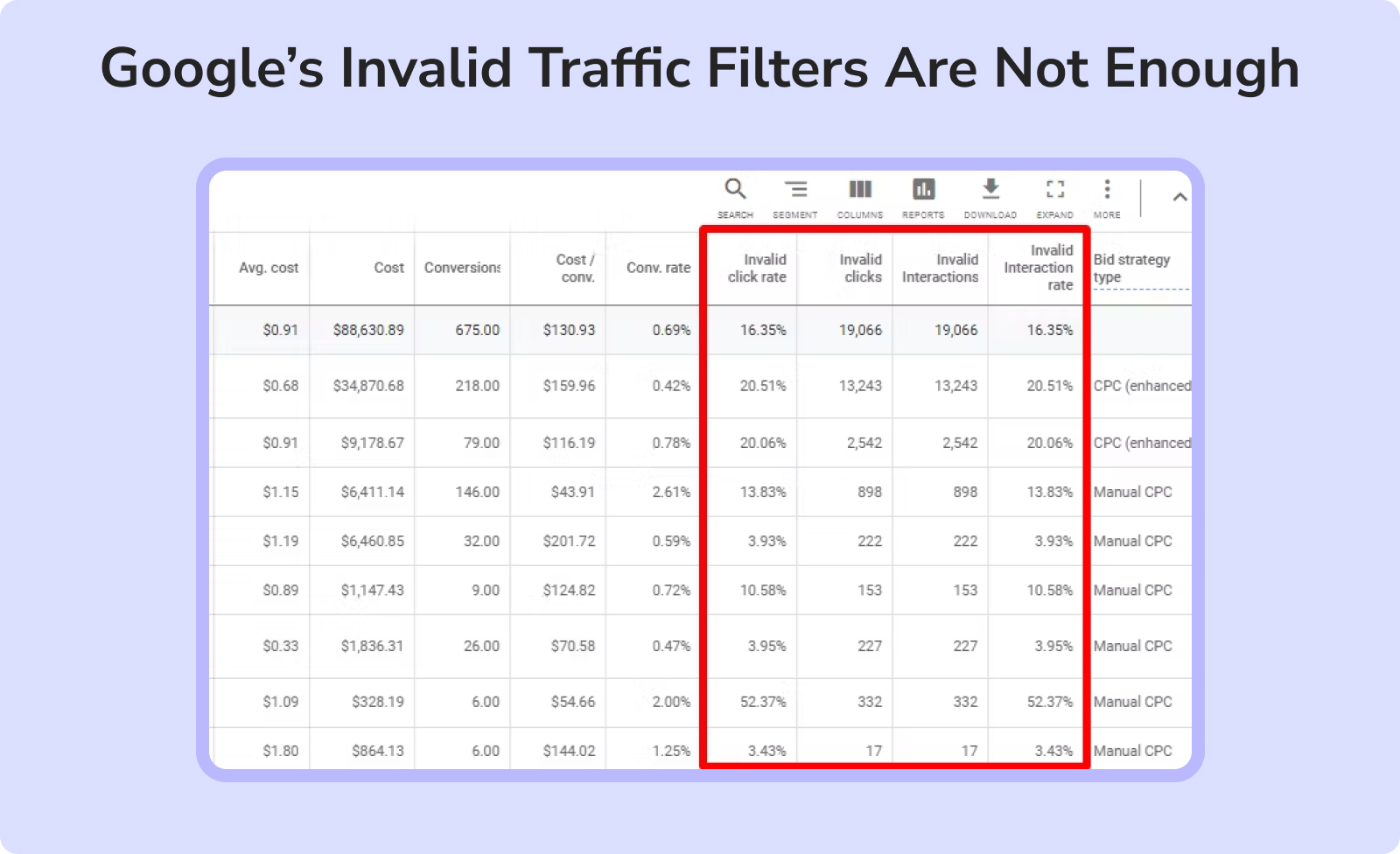
But there are four major reasons why these filters aren’t sufficient for many advertisers.
Their filters are designed to catch fraud egregious enough to damage advertiser trust, not to maximize refunds issued. Advertisers regularly report invalid traffic that Google never flagged, and when they do try to claim a refund, the process is opaque and rarely satisfying.
An example here is a typical email response from Google Ads when requesting a refund for invalid clicks.

We experienced a similar pattern during an independent test of Google’s AI Max feature: daily spend jumped 4.5X. Google’s defaults consistently push toward more spend, not better spend.
Sophisticated bots that use residential proxies, mimic human browsing behavior, or spoof device IDs won’t trigger system-wide flags. These can silently drain your budget, and Google will never classify them as invalid.
If invalid traffic reaches your account and engages with your site, the algorithm will incorporate those signals. Even if Google’s filters catch a click after the fact and refund you, your smart bidding data is still poisoned. The ads will continue to display to bot users since they’ve shown high engagement activity.
A competitor clicking your ad twice a week from a real device in your target city isn’t necessarily invalid, since they are not a bot, are within your target area, and are genuinely interested in your subject area. Google’s filters catch bots, not waste.
The bottom line is that, for many advertisers with any kind of exposure to invalid traffic, Google’s filters are helpful, but they don’t catch all the wasteful clicks.
Understanding that your campaigns need click fraud protection is one thing, but ensuring the tool you pay for works is another.
Here is an objective framework for verifying the impact of any click fraud protection tool on your campaigns:
Before signing up for a solution, pull 30-60 days of your campaign data and record the following as a baseline:
After paying for a click fraud protection tool, compare your baseline with the post-protection data. If it works, you should see the data moving in a specific direction.
Fraud Blocker protects over 4,500 client accounts, and below, we share what we detected across five of the most exposed industries in Q1 2026, compared to what Google reported for the same accounts.
💡Disclosure: We are a click fraud protection provider, so treat this as first-party data rather than independent research.
| Industry | Google's Reported Invalid Rate | Fraud Blocker Detected | % Invalid Traffic Missed by Google | Loss at $10K/mo Spend |
|---|---|---|---|---|
| Legal | 10.9% | 14.7% | 3.8% | ~$4,560/year |
| Finance | 5.9% | 11.4% | 5.5% | ~$6,600/year |
| Education | 8.0% | 13.0% | 5.0% | ~$4,800/year* |
| Home Services | 8.6% | 12.5% | 3.9% | ~$4,680/year |
| Healthcare | 8.1% | 10.4% | 2.3% | ~$2,760/year |
*Education loss estimated at $8K/mo, their typical smaller spend tier.
At $10K/month in legal, you’re losing an estimated $4,560/year to the invalid clicks that Google misses. At that budget level, most click fraud protection tools typically cost between $200 and $500 per month, depending on the volume of ad traffic protected per month. That means the tool will pay for itself many times, based on our detection numbers.
Click fraud prevention software isn’t for every advertiser. If you run modest budgets on well-controlled search campaigns in low-fraud verticals, Google’s native filters are probably enough, and you can usually skip a separate tool.
But if you operate a large budget, compete in high-CPC verticals, or have found quality issues in your paid traffic, it’s worth considering a click fraud protection solution.
The only way to know if it’s worth it for your specific account is to test it. Try Fraud Blocker free for 7 days and measure it against your own baseline.

ABOUT THE AUTHOR
Matthew is the resident content marketing expert at Fraud Blocker with several years of experience writing about ad fraud. When he’s not producing killer content, you can find him working out or walking his dogs.
Matthew is the resident content marketing expert at Fraud Blocker with several years of experience writing about ad fraud.