



[Exclusive] How Your Recycled Phone is Powering the Latest Click Farms
Our team gained rare access to click farms in Vietnam where we photographed "box phone farms" powering a new scale of fake engagement.


We improve your ad performance by blocking click fraud and fake emails



Click fraud is costing advertisers billions in loses. Learn more here.

Click fraud is costing advertisers billions in loses. Learn more here.



Read our in-depth study by independent research firm Juniper Research.



 Key Takeaways
 Financial services is one of the most competitive verticals in Google Ads, with costly CPCs, high customer lifetime values, and always-on campaigns. Unfortunately, these are the exact conditions where click fraud thrives.
Our research found that a significant share of Google ad clicks in finance come from bots and bad actors that will never convert into leads, and nearly half of it evades Google’s filters.
In this report, we quantify the problem and identify exactly how much different sizes of financial advertisers are losing to click fraud.
We analyzed data from Q1 2026 across 40+ US financial services Google Ads accounts, 365,000+ clicks, and over $1 million in ad spend. Our analysis covers the full spectrum of financial services advertising (banking and credit, insurance, and mortgage lending) as defined by the Global Industry Classification Standard (GICS).
Finance is one of the biggest targets for invalid clicks, and it comes down to the amount of money moving through these campaigns. A few hundred clicks across a dozen accounts can generate thousands in revenue for bad actors. That makes financial services ads highly attractive.
Additionally, finance keywords are among the most expensive, and clicks costing $200+ are not unusual. Diverting even a dozen clicks here is a sizable profit.
Competitors add a third layer of incentive for click fraud in finance. If you’re a mortgage provider, loan company, or insurer, the customers your ads pull in could be worth thousands in lifetime value. Competitors who can click your ads and drain your daily budget can suppress your visibility, clear the auction, and position themselves to win the customers you were paying to reach.
Finance advertisers in our data saw an 11.4% average click fraud rate.
For the same set of finance Google Ads accounts, Google identified a 5.9% invalid click rate. These clicks were automatically refunded to advertiser accounts.
 Expand to view chart data
 | METRIC | INVALID CLICK RATE |
|---|---|
| Google's reported invalid click rate (all Google Ads campaign types, US, financial services) | 5.9% |
| Fraud Blocker's detected invalid click rate (same accounts) | 11.4% |
| Difference | 5.5% (93% more than Google reported) |
Source: Fraud Blocker internal data, Q1 2026. Sample: 40+ US financial services Google Ads accounts.

But the delta between both rates is 5.5%. These are invalid clicks that were not identified by Google and will never convert to real leads.
Put another way, the invalid clicks in finance are 93% higher (nearly double) what Google actually reports. If Google’s number is what you see in your dashboard today, you’re seeing about half the real picture.
We’ve analyzed click fraud in multiple industries and verticals, and finance has one of the highest rates of clicks missed by Google. Two reasons stand out:
 Expand to view chart data
 | METRIC | VALUE |
|---|---|
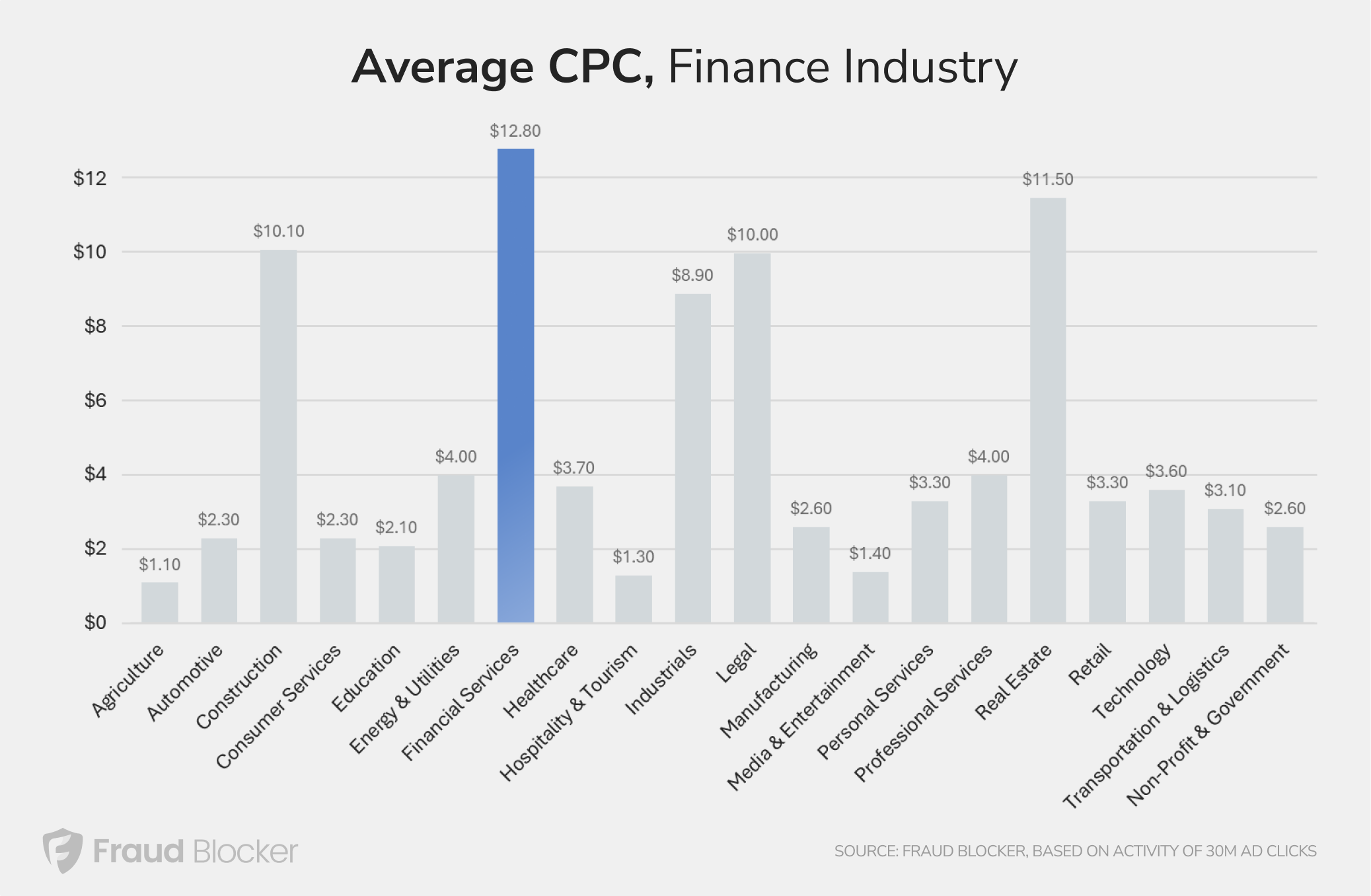
| Average CPC | $12.80 |
| Clicks analyzed | 365,000+ |
| Total ad spend analyzed | $1,000,000+ |
| Channels covered | Search |
| Account type | Financial services advertisers, US |
Source: Fraud Blocker internal data, April 2025 - March 2026 (January–March).
For US search, the average CPC for finance advertisers is $12.80, according to our dataset.
At a 5.5% difference in invalid activity, that means finance advertisers are losing 70 cents per click.
70 cents is not a big number, but when you contextualize it in terms of annual losses, the picture becomes clearer. Below is a table breaking that down in terms of losses per type of firm.
| YOUR SCENARIO | ANNUAL GOOGLE ADS SPEND | ANNUAL INVALID CLICK DIFFERENCE (5.5%) |
|---|---|---|
| Independent advisor / small RIA ($2,500/mo) | $30,000 | $1,650 |
| Small firm — insurance broker, mortgage broker ($10K/mo) | $120,000 | $6,600 |
| Mid-size firm — regional bank, fintech startup ($30K/mo) | $360,000 | $19,800 |
| Large firm — national lender, large insurer ($75K/mo) | $900,000 | $49,500 |
| Agency managing 10 finance clients @ $10K/mo | $1,200,000 | $66,000 |
| Agency managing 20 finance clients @ $10K/mo | $2,400,000 | $132,000 |
Derived from the 5.5% gap rate applied to stated annual Google Ads spend. Source: Fraud Blocker internal data, Q1 2026.
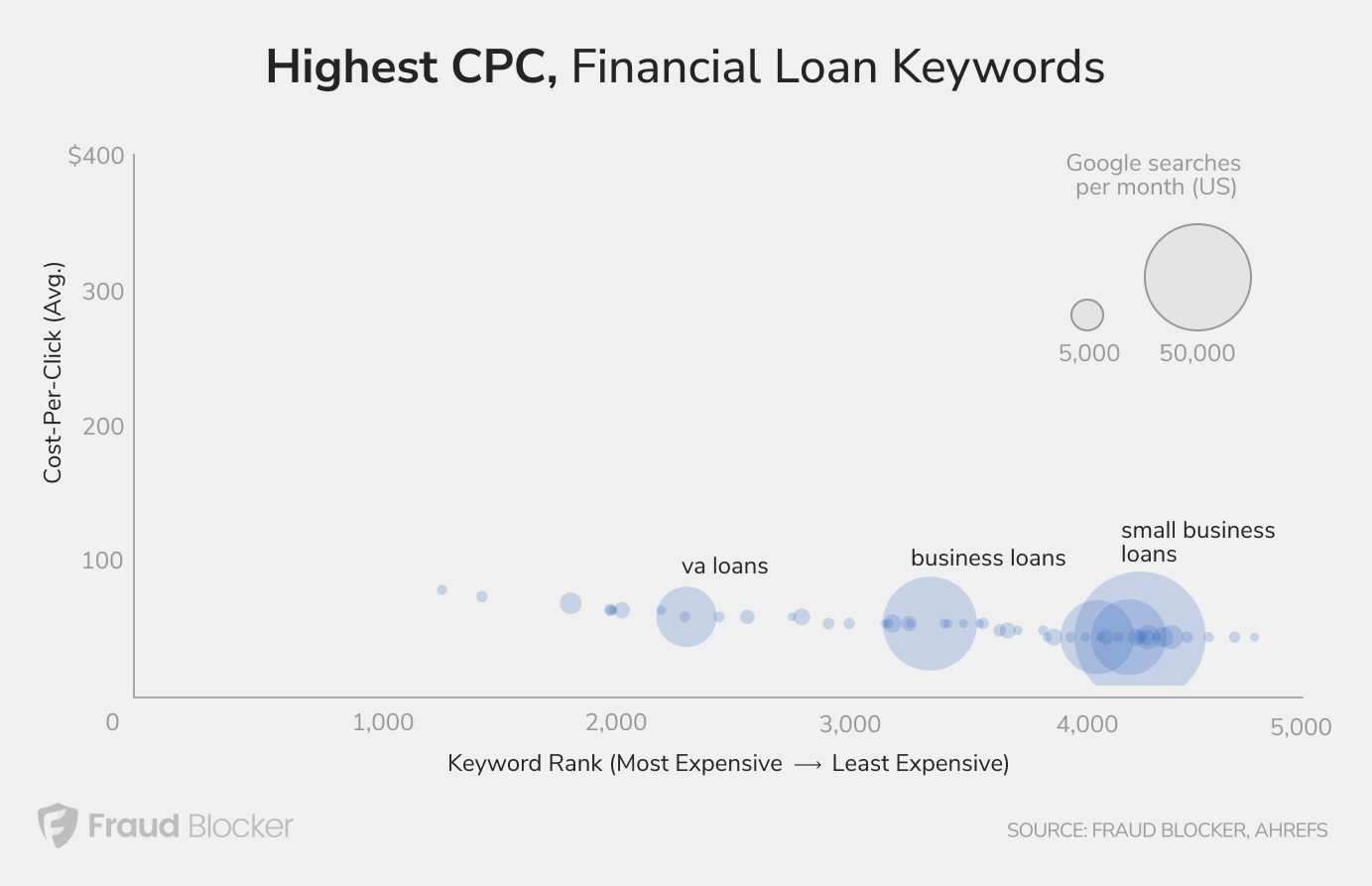
Finance advertisers lose even more on high-intent money keywords like “Best car insurance in North Carolina” where average CPCs are well over $200.
 Expand to view chart data
 | KEYWORD | CPC | INVALID CLICK RATE | LOSS PER CLICK |
|---|---|---|---|
| Best car insurance in North Carolina | $220.00 | 5.5% | $12.10 |
| Auto insurance quote | $100.00 | 5.5% | $5.50 |
| Small business insurance | $80.00 | 5.5% | $4.40 |
| VA loans | $70.00 | 5.5% | $3.85 |
Source: Fraud Blocker internal data, Q1 2026.
Financial keywords are disproportionately targeted by click fraud as bad actors stand to gain more per wasted click. But the immediate wasted clicks and lost budgets are only part of the problem with click fraud in the finance industry.
If bots or competitors are clicking your ads and landing on pages that must carry specific disclosures (APR, risk warnings, licensing), those fraudulent sessions skew your analytics. They make it look like your compliant pages are underperforming when they’re actually just being gamed.
Acting on that data means optimizing against fraud rather than for performance. So budget gets reallocated from pages that are actually working because of signals that were never real.
When a single click on a keyword like Best car insurance in North Carolina costs $220, one fraudulent click consumes the equivalent of 17 average-cost clicks across the broader market (where the average CPC is $12.80.)
If you’re an agency, this kind of waste becomes hard to justify on a performance report, especially when CPCs are already hard to explain to clients unfamiliar with how competitive the vertical is.
For in-house teams, large spend with few leads becomes very difficult to defend, especially when budgets are already closely scrutinized. The challenge becomes explaining whether the poor campaign performance is real or fraud-related.
In financial services, displacing a competitor for a single high-value customer (a mortgage, a business loan, or a commercial insurer) can be worth thousands in lifetime value. That makes click fraud economically rational.
If a competitor can exhaust your daily budget with cheap bot traffic, they clear the auction and capture customers you paid to attract. The return on a fraud-as-a-service investment can easily outweigh its cost if they win a customer worth $10,000+ in lifetime revenue.
Finance keywords trend consistently, as customers are always searching for loans, insurance, and investment products.
That means campaigns targeting these terms run continuously, an advantage bad actors can easily exploit. A permanently active campaign is a consistent target they can pattern-match and drain on a predictable schedule.
As long as your campaigns are running, the opportunity for invalid traffic exists. And Google’s filters only go so far; our data shows they catch only half of invalid clicks in this industry, meaning the other half can quietly erode your budget.
Read more: Click fraud in Google Ads explained.
An agency managing 10 finance clients at $10,000 per month is losing an estimated $66,000 annually to invalid clicks. Those losses are spread across multiple accounts, making them difficult to spot or explain.
High CPCs with underwhelming lead volume is already a difficult conversation to have with finance clients. But when invalid traffic is compounding that underperformance, explaining poor results without a clear cause becomes that much harder.
To a client, low success rates from poor campaign management is very similar to low success from click fraud. Over time, this could erode their trust in your agency, potentially costing a hard-won client account.

Finance advertisers are operating in one of the most expensive and easily targeted verticals in Google Ads. High CPCs mean every wasted click costs more, and the 5.5% of invalid clicks that Google doesn’t catch or refund can equal thousands wasted, up to $6,600 annual waste on a $10,000 monthly budget and even more for larger spenders.
Reactive strategies like geo-targeting and blocking IPs can help, but they aren’t perfect. And sophisticated bots can still slip through, as our analysis of 200 million ad clicks shows.
Fraud Blocker works in real time, detecting and blocking sophisticated invalid traffic sources BEFORE they reach your campaigns. Start a free 7-day trial today and see how much wasted ad spend you can recover.
This report aggregates across the three GICS finance subsectors—banking and credit, insurance, and mortgage lending—rather than reporting separately. Sub-vertical-level claims would require a larger sample per sub-sector than this dataset supports. We’ll publish sub-vertical data when we have it.
Invalid click rates in this report were detected using Fraud Blocker’s Intelligent Detection system, which analyzes 100+ signals per click, including device fingerprinting, IP behavior patterns, click frequency, VPN/TOR detection, and headless browser identification.
The comparison baseline is Google’s own reported invalid click rate for the same accounts over the same period, taken directly from the Google Ads invalid clicks metric. Average CPC figures reflect the mean cost-per-click across accounts in the financial services sample for the same period.
Fraud Blocker’s figure of 11.4% is lower than industry estimates because it reflects directly observed activity across 40+ active US financial services Google Ads accounts in Q1 2026. Our figure is neither a projected estimate nor based on industry theories.
No. Google only refunds the invalid clicks its own filters catch. Our data shows that Google’s filters miss about 5.5% of invalid clicks in financial services ads, and legal advertisers end up paying for these.
Finance advertisers can use measures like IP exclusions and geo-targeting to reduce exposure, but these won’t catch sophisticated invalid traffic. Real-time detection tools like Fraud Blocker identify and block invalid traffic before it reaches your campaigns, preventing the spend rather than attempting to recover it after the fact.
Finance campaigns are targeted by automated bots that generate clicks at scale, competitor click fraud designed to drain daily budgets and clear the auction, and click farms that mimic human behavior closely enough to evade broad filters.
Fraud Blocker detected an 11.4% invalid click rate across 40+ US financial services Google Ads accounts in Q1 2026. Google reported a 5.9% invalid click rate for the same accounts, which is 93% lower than what Fraud Blocker found. The 5.5% difference represents invalid clicks that Google did not catch and did not refund.
At the 5.5% unrefunded gap rate and an average CPC of $12.80, finance advertisers lose approximately 70 cents per click to invalid traffic Google doesn’t catch. Annualized, that ranges from $1,650 for a small independent advisor spending $2,500 per month, to $49,500 for a large national lender $75,000 per month.

ABOUT THE AUTHOR
Brandon is the co-founder and Chief Growth Officer at Fraud Blocker with 15+ years of performance marketing experience and $100M in direct ad spend management. He specializes in driving growth and maximizing ROAS across B2B SaaS, fintech, marketplaces and more.
Brandon is the co-founder and CGO at Fraud Blocker with 15+ years of performance marketing experience. He specializes in driving growth and maximizing ROAS across B2B SaaS, fintech, marketplaces and more.
SHARE
INFO
 Source:
Fraud Blocker
 Date:
Date:
 Methodology:
Data is based on an analysis of more than 48 million Google Ads clicks across 23,000+ campaigns in 60+ countries during Q1 2026, representing $42.5 million in monitored ad spend ($170 million annualized).
The finance subset analyzed in this report covers 200+ finance campaigns across 40+ advertisers, with Google Search clicks and $1M+ in financial services ad spend during the same period. All data is anonymized and aggregated at the campaign level.