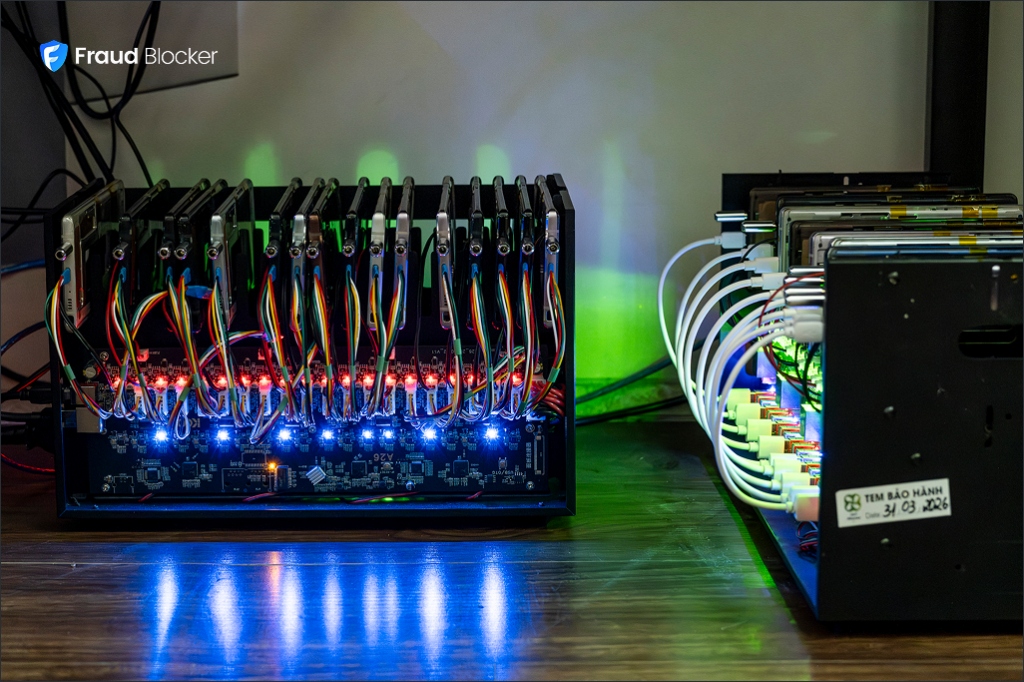



[Exclusive] How Your Recycled Phone is Powering the Latest Click Farms
Our team gained rare access to click farms in Vietnam where we photographed "box phone farms" powering a new scale of fake engagement.



Our AI agents catch the sophisticated fraud others miss and it tells you why. Learn more here.



Click fraud is costing advertisers billions in loses. Learn more here.

Click fraud is costing advertisers billions in loses. Learn more here.



Read our in-depth study by independent research firm Juniper Research.



 Key Takeaways
 Education is a highly competitive vertical in Google Search. Keywords like “online colleges” regularly hit $70 per click, driven by institutions, lead gen networks, and EdTech platforms all competing for the same prospective students.
Besides the budget waste, click fraud in this industry diverts spend away from real prospective students and corrupts the enrollment data advertisers rely on to optimize their campaigns.
For this report, we analyzed data from Q1 2026 across 60+ US education Google Ads accounts, over 2M clicks, and $1.9M+ in ad spend. Below, we share our findings, breaking down how much different advertisers are losing and what you can do to protect your budget.
One of the major problems with click fraud in education is the long consideration cycle and customer journey timeline. Here, advertisers don’t see a conversion in campaigns until weeks or months down the line, meaning click fraud patterns won’t show up in the reports until much later after they’ve affected several campaigns.
But there are other factors that make click fraud prevalent in education:
We analyzed a sample of US Google Search education campaigns to find out exactly how much click fraud is in the industry. Our team reviewed 60+ US education Google Ads accounts – with over 2M clicks and $1.9M+ in ad spend across Q1 2026 – to measure how much click fraud the industry actually carries.

 Expand to view chart data
 | METRIC | INVALID CLICK RATE |
|---|---|
| Google's reported invalid click rate (all Google Ads campaign types, US, education) | 8% |
| Fraud Blocker's detected invalid click rate (same accounts) | 13% |
| Difference | 5% (62.5% more than Google reported) |
Source: Fraud Blocker internal data, Q1 2026. Sample: 60+ US education Google Ads accounts.
Our system identified an average invalid rate of 13% in the US education search campaigns we monitored.
For the same set of legal Google Ads accounts, Google’s average invalid click rate was 8%. These are clicks flagged and refunded by Google.
The difference, 5%, represents clicks that slipped through Google’s filters. These were wasted clicks that will never lead to a conversion.
Google’s filters don’t catch everything (they miss half of all invalid clicks in finance, for example). We believe the reason is that Google’s filters are built to protect its entire network, not specific advertiser campaigns. Additionally, fraud operations are more sophisticated than ever and have caught up to Google’s playbook.
With the growth of AI ad fraud, it’s likely Google’s filters will miss even more clicks in the future, even as losses to ad fraud are estimated to hit $170 billion by 2028.
Read more: Click fraud breakdown by industry → See how education’s invalid-click rate compares to finance, ecommerce, and other verticals.
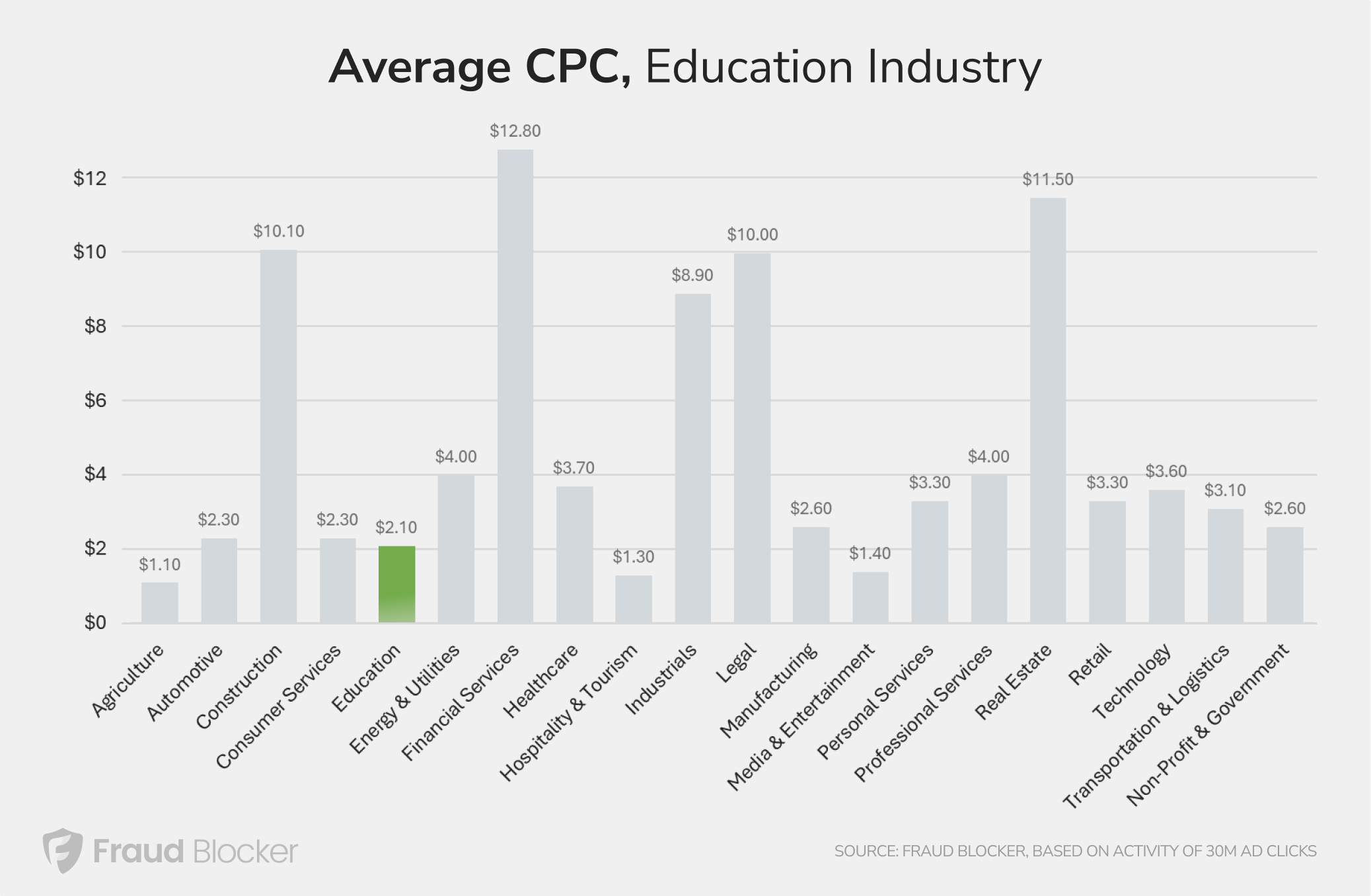 Expand to view chart data
 | METRIC | VALUE |
|---|---|
| Average CPC | $2.10 |
| Clicks analyzed | 31,000+ |
| Total ad spend analyzed | $65K |
| Channels covered | Search |
| Account type | Education Advertisers, US |
Source: Fraud Blocker internal data, April 2025 – March 2026.
10.5 cents lost per click can add up very quickly across an annual budget, even a modest one. For example, an advertiser with a $8,000 monthly budget can easily lose $4,800 to click fraud annually.
Here’s a table breaking down losses per advertiser size and budget.
| TIER | INCLUDES | ANNUAL BUDGET | INVALID CLICKS | ANNUAL WASTED SPEND |
|---|---|---|---|---|
| Small advertiser ($1k/mo) | Local tutoring centre, independent test prep tutor | $12,000 | ~286 | $600 |
| Medium advertiser ($8k/mo) | Bootcamp, trade school, professional certification body | $96,000 | ~2,286 | $4,800 |
| Large advertiser ($35k/mo) | National university, large EdTech platform, tutoring marketplace | $420,000 | ~10,000 | $21,000 |
| Enterprise advertiser ($200k/mo) | Lead gen network, student loan platform, corporate training provider | $2,400,000 | ~57,143 | $120,000 |
| Mega scale advertiser ($500k/mo) | Large university, dominant EdTech brand | $6,000,000 | ~142,857 | $300,000 |
Based on a 5% unrefunded invalid click gap and $2.10 average CPC. Conservative floor budgets used per tier. Source: Fraud Blocker / industry estimates.
On more expensive keywords, the losses increase. If you target keywords like “online colleges” and “psychology degrees” where demand is seasonal and the CPCs are high, your campaigns could lose a lot within a short period of time.
Here’s how much education advertisers are losing on the most expensive keywords in their category.
 Expand to view chart data
 | KEYWORD | CPC | INVALID CLICK RATE | LOSS PER CLICK |
|---|---|---|---|
| Online colleges | $70.00 | 5% | $3.50 |
| Psychology degree | $63.00 | 5% | $3.15 |
| Best online colleges | $58.00 | 5% | $2.90 |
| BSN degree | $52.00 | 5% | $2.60 |
| Finance degree | $48.00 | 5% | $2.40 |
Source: Fraud Blocker internal data. Based on 5% unrefunded invalid click rate.
Budget drain is far from the only problem with click fraud in your education campaigns. There’s also data corruption, artificially inflated leads, and even broken campaign optimization strategies.
Here are the ways click fraud can negatively affect your campaigns.
CPCs can regularly exceed $70 for keywords like “online colleges,” which means a single fraudulent click costs more than 33 times the industry average. Fraudulent clicks can easily add up at a campaign level, too. Even a low fraud rate on a university’s campaign can waste over $300,000 annually.
Even small advertisers can lose around $4,800 annually with an $8k monthly budget.
During peak inquiry windows (August–September and January), institutions typically increase their ad spend to capture prospective students who are ready to make a decision. Invalid clicks here waste spend budgets, but more importantly, they can reduce visibility when it is most important.
As bad actors drain daily budgets and force ads out of auction earlier in the day, prospective students won’t encounter your brand, causing you to miss legitimate inquiries.
When fraudulent clicks accumulate against specific high-CPC keywords or ad groups, the data signals that those placements are working. So your campaign leans into them further, resulting in a feedback loop that keeps spending in the wrong places.
If you are an independent institution spending $8,000 a month, our data shows that you pay for 2,286 invalid clicks every year (at a 5% invalid click rate) and lose $4,800 to traffic that will never convert into an enrolled student.
These losses rarely show up in reports and are thus harder to catch. Without dedicated fraud tools, they get misattributed to poor campaign optimization, weak targeting, or underperforming creative.
When you look at enrollment marketing agencies, the losses are even bigger. Managing client budgets at $200,000 a month means overseeing $2.4 million in annual ad spend. At a 5% invalid click rate, that is over 57,000 fraudulent clicks and $120,000 in wasted spend, per client, per year.
If your agency manages multiple institutions simultaneously, the unrefunded spend across your book of clients represents budget that could have driven real inquiries, applications, and enrolled students for the institutions that depend on your team.

Global losses to ad fraud are projected to reach $170 billion by 2028. For education advertisers on Google Search specifically, our data shows that invalid clicks cost you 10.5 cents on every dollar spent.
An independent institution spending $8,000 a month loses $4,800 a year to unrefunded invalid clicks. If you’re an enrollment marketing agency managing an enterprise client, that figure rises to $120,000 per account per year.
But Fraud Blocker can help you stop these losses at the click level. Our platform monitors your education campaigns in real-time and automatically blocks fraudulent IPs from seeing your Google Ads, adding them to your exclusion lists before they can drain more budget.
Based on our platform data, advertisers in education on a $100,000 annual budget recover an average of about $13,000 a year in spend that would otherwise go to invalid clicks.
The 5% of invalid clicks Google never refunds is exactly what Fraud Blocker’s Intelligent Detection is built to catch. We filter fraudulent traffic on your Google and Meta campaigns before it drains the budget meant for real prospective students.
Find out how much your campaigns are losing and how much is recoverable.
Start a free 7-day trial. No commitment required.
Across 2M+ US education Google Search clicks analyzed, Fraud Blocker found that 13% were invalid. Google reports just 8%, meaning 5 in every 100 clicks are fraudulent, undetected, and charged to your budget.
It depends on your budget. According to Fraud Blocker’s analysis, an independent institution spending $8,000 a month loses approximately $4,800 a year to unrefunded invalid clicks. An enrollment marketing agency managing $200,000 a month loses around $120,000 per client per year.
Yes, partially. Google’s filters detect and refund a portion of invalid clicks automatically, but our data shows they miss 5% of invalid activity in education accounts. That gap is what advertisers pay for with no refund.
Beyond budget waste, click fraud displaces real prospective students from your budget and corrupts your campaign data. Invalid clicks skew click-through rates, quality scores, and conversion data, meaning every optimization decision made from that data moves your campaign further in the wrong direction.

ABOUT THE AUTHOR
Brandon is the co-founder and Chief Growth Officer at Fraud Blocker with 15+ years of performance marketing experience and $100M in direct ad spend management. He specializes in driving growth and maximizing ROAS across B2B SaaS, fintech, marketplaces and more.
Brandon is the co-founder and CGO at Fraud Blocker with 15+ years of performance marketing experience. He specializes in driving growth and maximizing ROAS across B2B SaaS, fintech, marketplaces and more.
SHARE
INFO
 Source:
Fraud Blocker
 Date:
Date:
 Methodology:
Data is based on an analysis of more than 48 million Google Ads clicks across 23,000+ campaigns in 60+ countries during Q1 2026, representing $42.5 million in monitored ad spend ($170 million annualized).
The education subset analyzed in this report covers 3,900+ finance campaigns across 60+ advertisers, with Google Search clicks and $1.9M in financial services ad spend during the same period. All data is anonymized and aggregated at the campaign level.