




22 Best Google Ads Optimization Tools in 2026, by Use Case
Compare 22 of the best Google Ads optimization tools and software for 2026. Covers bid management, ad testing, research, and automation.




We improve your ad performance by blocking click fraud and fake emails



Click fraud is costing advertisers billions in loses. Learn more here.

Click fraud is costing advertisers billions in loses. Learn more here.



Read our in-depth study by independent research firm Juniper Research.



This summer, Fraud Blocker’s team gained exclusive access to several active click-farming operations in Hanoi, Vietnam.
The photos are a stark contrast from the old-school image of a traditional click farm in a dimly lit room where workers frantically tap on walls of glowing smartphone screens to fake likes, views, and followers.
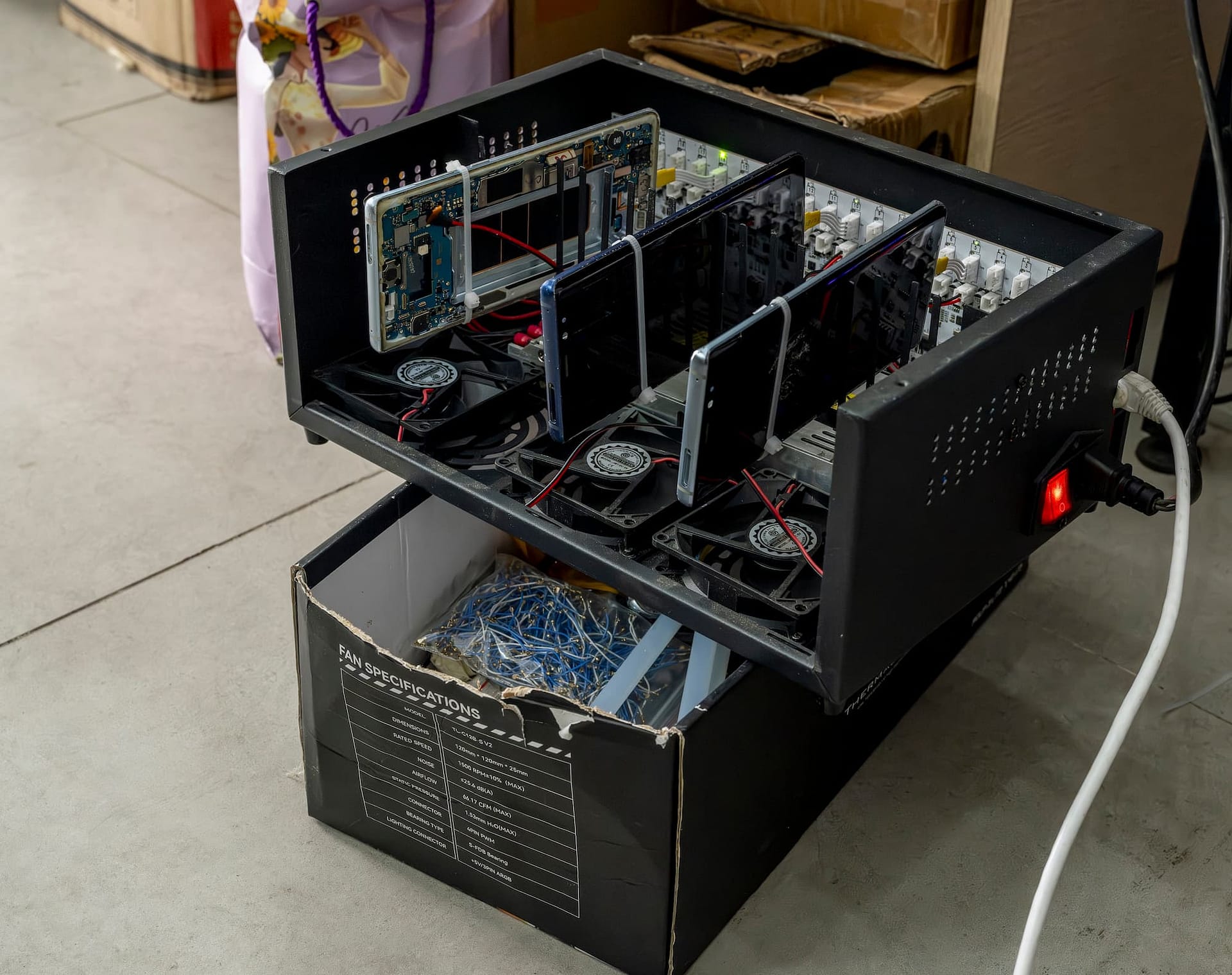
Instead, the chaotic “walls of phones” have been replaced by silent, stacked, metallic server chassis. The screens are gone; the batteries are gone. What remains are hundreds of stripped down smartphone motherboards packed into compact enclosures known as “Box Phone Farms.”
This technology has evolved from a clumsy, localized gray-market hustle into a highly automated, service-focused businesses with global customers. Operating out of hubs in major cities like Hanoi and Ho Chi Minh City, these farms are powered by AI-driven software and are readily available in many mainstream online retail stores. All in an effort to make online fake engagement and accounts as easily accessible as possible.
Box phone farms appear to be accelerating fake engagement online including artificially boosting video views, social media likes, advertising fraud, political content and more. According to the 2026 Imperva Bad Bot Report, real humans are officially the minority online with automated bots now generating a staggering 53% of all internet traffic.
Even more alarming, malicious “bad bots,” designed purely for scraping, fraud, and metric manipulation, account for 40% of that global total. This automated onslaught comes with a massive financial toll: global digital ad fraud losses are projected to reach $133 billion by 2028, fueled by an ecosystem where 10% to 25% of paid traffic on major advertising networks originates from completely non-human sources. Even on mainstream social platforms like Meta, an estimated 4% to 5% of monthly active users are entirely fake accounts.
To understand the scale of these operations, one must understand the hardware redesign of the box phone farm.
In older setups, keeping hundreds of cheap smartphones running plugged into individual chargers was a logistical nightmare and a massive fire hazard due to swelling lithium-ion batteries. Modern box phone farm operators have engineered an elegant, minimalist solution: they completely strip the devices.
In June 2026, our team gained access to several click farm operations in Hanoi Vietnam and what we found was a stark departure from the chaotic internet cafes of the past.
The sophistication of these operations is no longer an industry of low-skilled laborers, but rather it is run by tech professionals.
One employee from a prominent operator interviewed by Fraud Blocker was a former software engineer, and another spent years working in game operations and cryptocurrency NFT platforms. One veteran operator, who began tinkering with hardware four years ago, was previously a rocket scientist. “China started this software, but Vietnam developed it more and improved it,” he says.
The scale of these operations is staggering. While the country features two or three massive, institutional click-farm kingpins, there are countless smaller, decentralized operations that are impossible to keep track of. A standard mid-tier farm can efficiently handle anywhere from 400,000 to 500,000 fake accounts simultaneously.
"The demand is bigger and bigger, so now I see businesses using more boxes, with more professional setups and a bigger customer base," explains one self-employed Vietnamese farm operator interviewed by our team.
The client base is truly international. Operators report steady streams of revenue from local Vietnamese businesses, but the vast majority of high-paying clients reside abroad. Orders flood in from Dubai, Thailand, Turkey, Japan, Australia, the United States, and major European nations like France. In Latin America, demand is surging across Argentina, Colombia, the Dominican Republic, and Mexico.
Some international clients do not just buy fake engagement services; they buy the physical hardware infrastructure. “We have customers that have a warehouse full of our boxes,” a sales representative for a 10-person operation spanning Hanoi and Ho Chi Minh City revealed. “We install the boxes for them and support them with the software updates. If something malfunctions, we replace it.”
One might assume that acquiring a specialized, server-grade machine built out of stripped consumer smartphones requires navigating illicit dark web marketplaces or shady supply chains in Shenzhen.
The reality is far more alarming: it is available via mainstream e-commerce stores.
For an aspiring click-farm operator, fully built, plug-and-play box phone farms are indexed openly on mainstream retail platforms like eBay, Alibaba, and even Amazon. For example, listings such as the “Android Farming Machines” are readily available in the store today and intentionally avoid the “box phone farm” label to skirt the automated scanning systems based on banned keywords. These sellers provide turnkey 20-device motherboard rigs built directly from rooted Samsung components. These devices arrive pre-assembled, pre-configured, and ready to be plugged into a standard wall outlet to begin mass-generating traffic.
For larger operations looking to scale at minimal cost, Amazon and global electronic wholesalers function as a raw component pipeline. Operators use these platforms to buy industrial 20- or 40-port USB charging hubs, blank server chassis, and cooling fans in bulk.
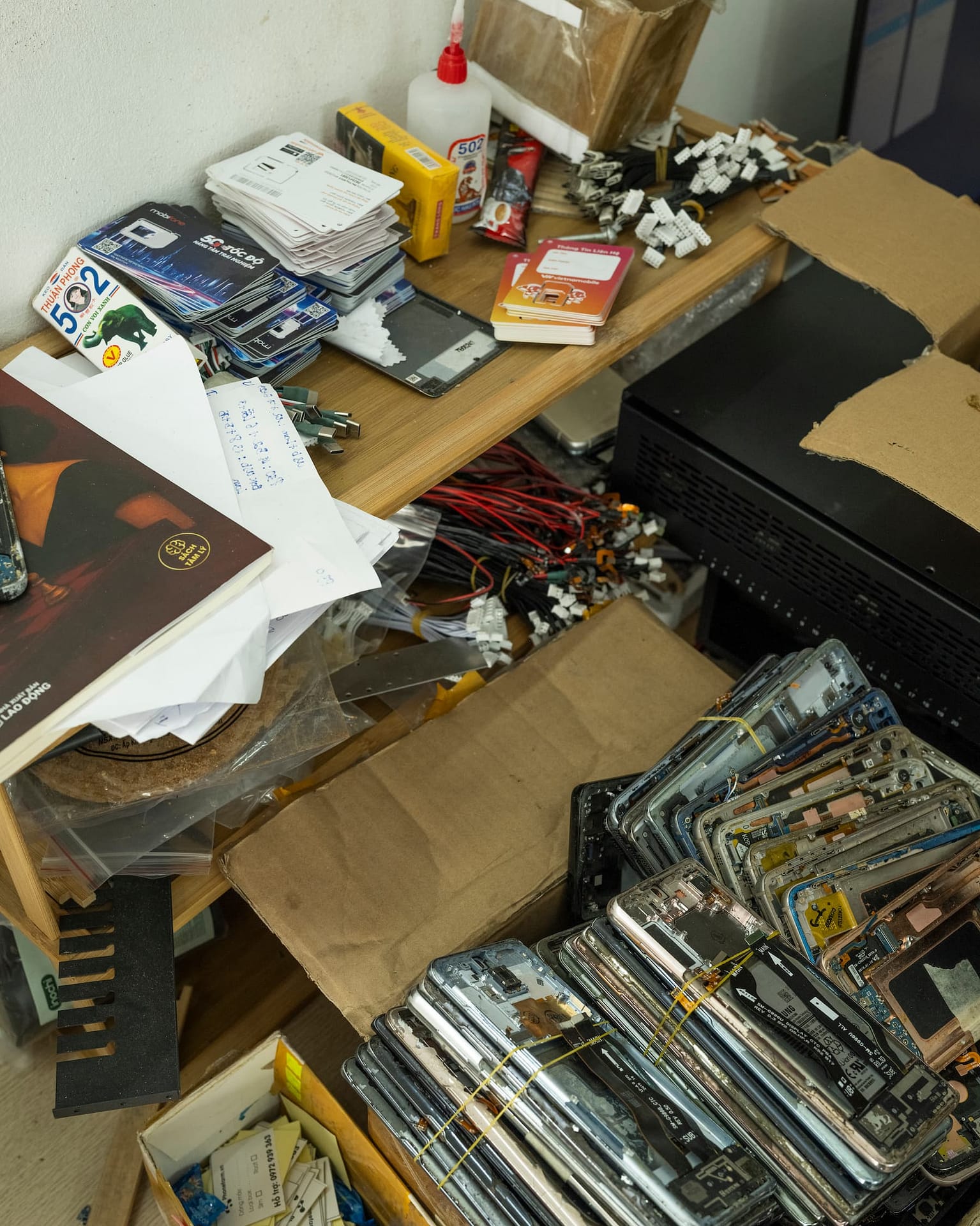
To source the core components, the motherboards of the phones, operators rely on massive second-hand device markets.
“Vietnam is the best place to buy used phones,” one farmer noted, pointing out that because major tech companies like Samsung set up manufacturing plants in Vietnam to utilize cheap labor, the local supply of parts is incredibly robust and inexpensive.
Operators buy broken, cracked, or older Samsung models (graduating over time from the Galaxy Note 8 to the Note 9, S10, and S20) directly from online marketplaces or localized middle-men. The cost ranges from a few hundred thousand VND (roughly $3.80 USD per 100,000 VND) to a few million VND per device.
Notably, you will almost never see an iOS-based box phone farm. “iPhones don’t allow customization and hacking; iOS has very high security,” an operator explained. Android’s open-source architecture makes it the universal standard for the industry.
Social media conglomerates like Meta, Google, TikTok, and X spend billions of dollars annually on automated security to detect bot traffic. Yet, they are consistently losing the arms race against box phone farms for two distinct reasons: genuine hardware integrity and artificial intelligence.
Security algorithms are highly adept at identifying and banning software-based device emulators because virtual environments leave distinct digital fingerprints. Box phone farms completely bypass this defense because they utilize genuine hardware. When a box farm logs into an app, the platform’s security scanners read the authentic IMEI number, a real Snapdragon or Exynos processor, and the physical network components of an actual Samsung Galaxy smartphone. To the platform, it looks exactly like an organic human user holding a physical phone.
To prevent hundreds of accounts from originating from the same IP address, farms utilize advanced network architecture. Using AI-driven proxy rotation tools, each individual motherboard in the box is assigned its own dedicated residential proxy, VPN, or physical SIM card array. This tricks the platform into believing that the 500 motherboards sitting in a single Vietnamese room are actually 500 independent citizens scattered across different cities globally.
The software landscape has advanced exponentially since 2023. Instead of relying on rigid, repetitive scripts that platforms easily flag as bot behavior, modern operations integrate sophisticated AI packages.
“AI allows complete automation,” says one crypto-gaming farmer. “AI has made the behavior of the phones appear completely human-like. There’s no more manual labor; it’s an engine that takes over social media management. This is called automated seeding.”
These AI packages perform what the industry calls smart account nurturing. Instead of immediately spamming a client’s link, the AI-controlled motherboards will spend hours organically scrolling through TikTok or YouTube feeds, pausing to watch videos, liking random posts, and writing contextually relevant comments using natural language processing. This hyper-realistic behavior triggers positive algorithm metrics, naturally inflating the account’s authority before it executes its commercial goal.
When a client wants to grow an account, the click farm deliberately avoids sudden, massive influxes of followers, which would trigger platform security flags. Instead, they program the followers to “trickle in” gradually over weeks to maintain a flawless illusion of organic growth.
The industrialization of the box phone farm represents a fundamental shift in the economy of online information. By condensing the hardware, eliminating the physical liabilities of older smartphones, and supercharging the system with human-mimicking AI, these operations have driven the financial cost of mass manipulation to historic lows.
From boosting e-commerce profiles on platforms like Shopee using automated video loops to running massive, automated “play-to-earn” cryptocurrency gaming rigs that pull real cash tokens out of video game ecosystems, the monetization vectors are infinite.
For just $1,000 USD, a client can purchase a massive suite of long-term interactive services. Want to double a YouTube channel’s subscriber base from 1 million to 2 million? An operator notes it takes just one to two months of calculated, daily hardware operations to systematically break the platform’s algorithm and force the content into the real public’s organic feed.
When asked about the ethics of building an empire on structural deception, one Vietnamese operator was blunt about the economic forces driving his industry:
“I guess it’s kind of wrong, but it’s much cheaper than paying for official advertisements on these platforms. If the platforms wanted people to use them organically, they should lower the price.”
As box phone farms become increasingly accessible, the barrier to entry is effectively vanishing. The line between what is real online and what is merely a programmed box of used phones in Vietnam has never been more blurred.
[This post was authored by Fraud Blocker’s Founder and CEO, Mike Schrobo]