


NEW New feature: Verify and block fake emailsLearn more
NEW New feature: Verify & block fake emails

Poll Bots: Faking Poll Results With Bots

Whether it’s political elections with digital votes, online polls on Instagram or X, or even  market research surveys, automated poll bots can be used to influence these votes, tipping the results in the favor of whoever controls them.

These bots are programmed to sway public opinion on various topics or political candidates and are prevalent on platforms that encourage discourse like X (formerly Twitter), Discord, Reddit, and others. Their results are often picked up and circulated by news organizations across the country, amplifying their impact.

In 2026 with AI and LLM infrastructure more sophisticated than ever before, poll bots have become harder to catch. They are able to  replicate human voting behaviors, and easily misrepresent what the public really thinks. 

This article aims to shed light on the nature of these bots, their operational mechanisms, and the steps you can take to identify and mitigate their influence. 

What is a poll bot?

A “poll bot” is a software program or bot designed to automatically participate in online polls. These bots can be programmed to cast votes repeatedly in an online poll, usually to sway the results in favor of a particular option. Poll bots are often used in situations where the outcome of an online poll is seen as significant or beneficial to certain groups or individuals.

They can skew the results of a poll, making it unreliable as a measure of genuine public opinion or preference. In some cases, their use can also be illegal, especially if they are used to manipulate public opinion or for fraudulent purposes.

The technology behind these bots can vary, but they typically operate by simulating human interactions with a website, such as clicking on a specific option or filling out a form. Advanced poll bots might use techniques to bypass security measures like CAPTCHAs or IP address checks, which are designed to prevent automated voting.

How do poll bots work?

To make multiple votes possible, poll bots often employ tactics to bypass common online poll security measures. These measures might include CAPTCHA tests, which are designed to distinguish between humans and bots, or systems that track IP addresses to limit the number of votes per user. Advanced poll bots might use optical character recognition to solve CAPTCHAs, or they might employ a network of proxy servers or VPNs to mask and change their IP addresses, allowing them to vote repeatedly without being detected.

In some cases, poll bots are part of larger networks called botnets, which use many computers to generate a high volume of votes. This scalability makes them particularly effective at swaying poll results. However, as online polling systems evolve and implement stricter security measures, poll bot programmers must continuously update their bots to navigate these new defenses.

Examples of a poll bot

Poll bots in X survey

In March 2025, a survey on X (formerly Twitter) asked whether German consumers would still buy Tesla vehicles. The results were found to be skewed by a t-online report that showed the influence of poll bots. Over 250,00 votes were found to originate from just two IP addresses in the US, massively skewing the results towards “yes.”

Market research fraud uncovered in 2025

Surveyors rely on online to recruit survey participants. But a 2025 peer-reviewed study found that an estimated 65 to 84% of Amazon Mechanical Turk (MTurk) workers seeking compensation submitted fraudulent survey responses. This was despite the researchers implementing best practice screening measures. The larger implication of this is that responses to similar online surveys could be inauthentic, powered by poll bots, without any indication.

Pol bots skewing results in real time

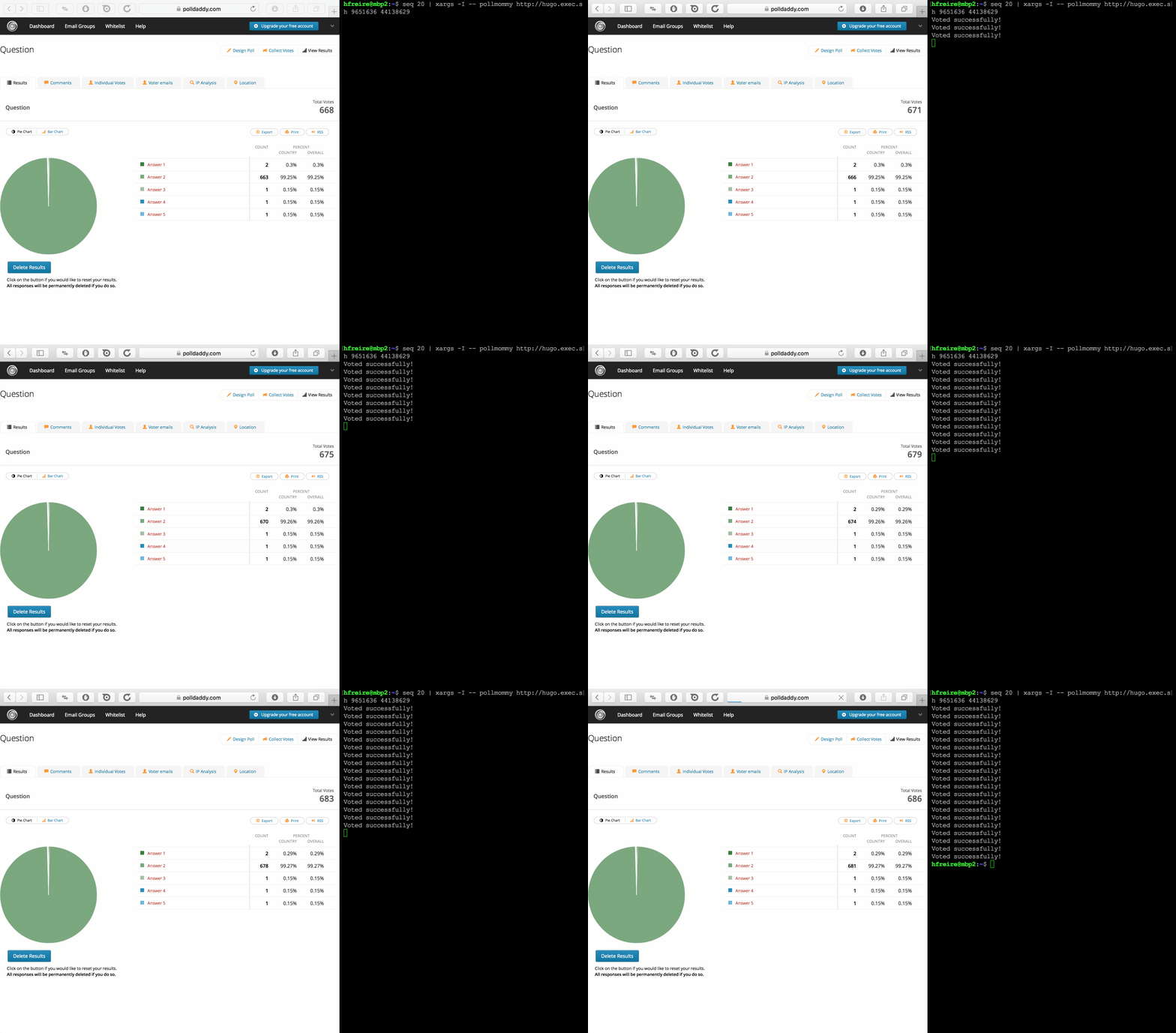
Below is a poll bot in action. In this case it’s being used to automatically vote on any poll using Crowd Signal’s leading polling platform. This polling software has been used by BBC, Microsoft, Forbes, and others.

6 Ways poll bots are used today

Here are some example scenarios where poll bots might be used, keeping in mind that these uses are typically unethical and often violate the terms of service of websites:

  1. Influence Public Opinion for Elections: This is a big one. Poll bots can be used to manipulate the results of online polls related to political or social issues. By artificially inflating the support for a particular viewpoint or candidate, the results can give a misleading impression of public opinion.
  2. Win Marketing Promotions: Companies or individuals might use poll bots to win online contests or polls where the results can lead to promotional benefits, like winning awards, gaining visibility, or receiving endorsements.
  3. Boost Popularity Contests: In the entertainment industry, poll bots may be used to influence votes in contests like online music charts, movie awards, or TV show polls, creating a false perception of popularity or fan base size.
  4. Sway Social Media Influence: On Instagram, X (formerly Twitter) and other social media platforms, poll bots can be deployed to sway the results of polls posted by influencers, brands, or media outlets, potentially affecting the perceived popularity or reception of products, services, or ideas.
  5. Manipulate Research Results: In some cases, poll bots might be used to skew online surveys or research polls, affecting the data collected. Sometimes, this is done to change the narrative, but sometimes, it simply simulates real responses so platforms don’t have to get as may respondents.
  6. Create a False Consensus: Poll bots can be used to create a sense of false consensus around specific issues, products, or beliefs, influencing public perception and discussion.

AI-powered poll bots are more sophisticated than ever

Poll bots have moved beyond being able to generate dozens of instances to answer yes/no in an online poll. A 2025 study from Dartmouth University found that AI bots can now mimic real human respondents 99.8% of the time with eerie accuracy.

These modern poll bots are able to:

  • Simulate human reading times, calibrated to education level
  • Create human-like movements on the mouse
  • Deliberately insert typos and corrections similar to a human

The study also concluded that between 10 to 52 of these poll bots were needed to sway a national election poll, skewing the true numbers on which candidate was ahead.

Smaller scale polls would likely need fewer AI generated poll bots, which threatens the integrity of most online polls into question.

How to detect if a poll bot has voted

Detecting if a poll bot has voted in an online poll can be challenging, but there are several indicators and methods you can use:

  • Unusual voting patterns: Sudden surges in votes, especially in a short time frame, can be a red flag. If a particular option in a poll receives an unusually high number of votes in a brief period, it might indicate bot activity.

  • Consistent voting intervals: Poll bots often vote at regular intervals, which can be more consistent than human voting patterns. Look for patterns in the time stamps of votes.

  • Similar IP addresses: Multiple votes from the same IP address, or from IP addresses that are known to be proxies or part of a VPN, can suggest bot activity. However, sophisticated bots might use a range of IP addresses to avoid detection.

  • Votes from unusual geographic locations: If the poll is intended for a specific geographic audience and you receive a large number of votes from outside that region, this might indicate bot activity.

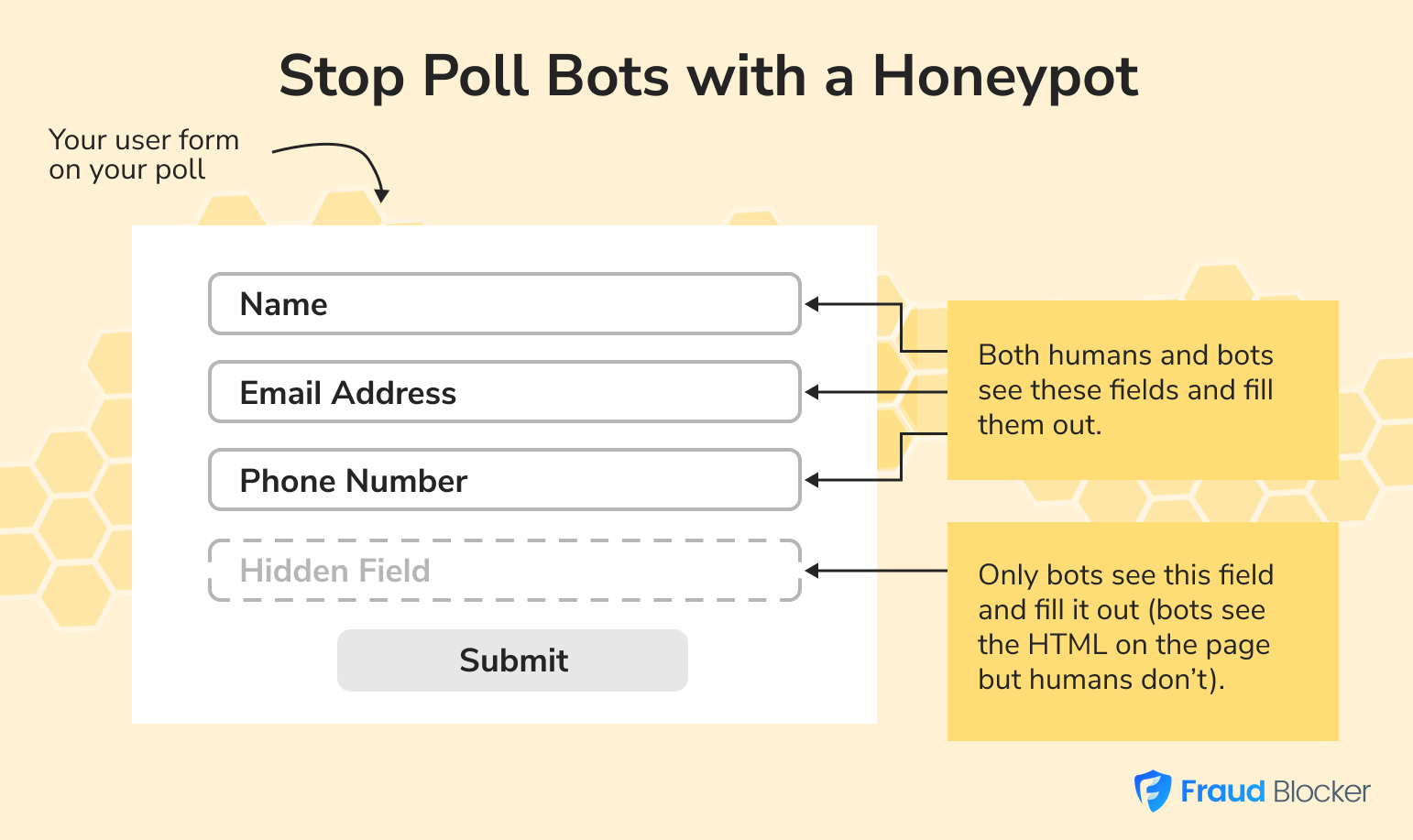
  • Completion of a hidden form fields: Honeypots are hidden fields that only bots see. Learn more about Honeypots.

  • Strange CAPTCHA effectiveness: If you have a CAPTCHA in place and still receive an unusually high number of votes, it might suggest that bots are successfully bypassing it.

  • Behavioral biometrics: Bots typically simulate clicks without the extra human behavior. Tracking mouse movement, scroll depth, and cursor hesitation before a vote can show automated activity that a simple click-through cannot.

  • NLP analysis: AI can now be used to detect AI. In open-ended responses, overly structured paragraphs, flawless grammar, and an absence of slang or natural variation can be tell-tale signs of bot-generated content.

  • Metadata fingerprinting: Automated frameworks like Playwright and Selenium have unique signatures like “Headless Chrome” browser headers or inconsistencies in user-agent strings. If found, these can signify that non-human voters have made submissions.

  • Low engagement rates: Low engagement or interaction rates compared to the number of votes (like comments or shares) can be another sign of bot activity.

How to make a poll bot

what is a poll bot warning

The development of a poll bot varies for each platform, with unique software needed for different sites like Discord, Reddit, or other polling platforms such as Crowd Signal (formerly known as PollDaddy). 

For those interested in creating a poll bot, there are a few key components required:

1)  Use a PollBbot script:

There are several open source scripts on github and you’ll need a basic developer understanding to use these tools:

    • PollMommy is one you can use to vote on Crowd Signal polls (formerly “PollDaddy”). As mentioned earlier, Crowd Signal polling platform is one of the largest on the market and used by major brands such as Forbes and the BBC.
    • Voter is a poll bot for use on Steam. We haven’t tried this ourselves as it’s an older script and you need to be logged in to use it, but it’s worth a shot.
    • AutoHotkey – This is software that can be used to program mouse movements to vote on polls. You can have it vote, then refresh the page, then vote again. Rinse and repeat.

2)  Buy many proxies:

Proxies are crucial for the operation of poll bots. They provide anonymity, speed, and the appearance of a widespread voter base. By cycling through various proxy IPs, poll bots can cast votes from different locations, thus bypassing security measures that detect and block repetitive voting patterns.

3)  Create many user accounts:

Certain polls restrict voting to one vote per user, necessitating unique accounts for each vote. This means creating multiple accounts with individual passwords, which can then be integrated into your poll bot script.
How to stop pollbots

To safeguard against the influence of pollbots, here are some effective measures to implement:

1. Add Honeypots: Honeypots are invisible fields embedded in the form’s code, invisible to human users but often filled out by bots scanning the code. Any response that includes data in these fields can be flagged as invalid. Honeypots are a subtle yet effective way to distinguish between human and automated responses.

2. Use Fraud Detection Services: Services like ours, Fraud Blocker, can be invaluable in identifying and stopping bot activities in online advertising. Other tools can help identify bots for non-paid traffic.

3. Require Identity Verification: To curb the proliferation of bots, integrating some form of personal identification verification can be crucial. Options include requiring a payment method on file or verification of an aged account status, adding an additional layer of security.

4. Report Suspected Bot Activity: In cases where bot activity is suspected, reporting to the administrators of the website or platform can be a critical step. They possess more extensive tools and access to data that can be used to investigate and address such issues.

5. Select a Reputable Poll/Survey Provider: When collaborating with external companies for conducting polls or surveys, it’s important to choose those with a strong reputation and proven measures to combat bot attacks. Ensuring the credibility and security of these providers is key to maintaining the integrity of your polls and surveys.

Adopting these strategies can significantly enhance the security and reliability of online voting systems, protecting them from the manipulative impacts of pollbots.

Stop poll bots with a honeypot

What is the business impact of poll bots?

Poll bots skew the results of online polls, but they can also corrupt your business’ survey data, creating a much bigger problem than rigged online contests.

When survey data is manipulated, product teams build roadmaps based on false demand, marketing teams allocate budget toward audiences that don’t exist, and brand sentiment reports reflect bot opinions rather than real ones. 

We’ve also seen that the same bot infrastructure that creates poll bots can also be used to create bots targeting lead generation forms. 

Left unchecked, the problem can cascade to

  • Wasted ad spend targeting audiences built on fake data
  • Sales team time lost to fraudulent or unqualified submissions
  • Skewed conversion data that obscures real campaign performance

Seeing bots in your ad campaigns?

If bots can rig a Eurovision poll, they can fill out your lead form. Fraud Blocker helps you block bots from your ad campaigns, preventing them from ever finding your lead forms, and boosting your overall campaign performance. 

Try our 7-day free trial and and see how much cleaner your pipeline can be.

Facebook
Twitter
LinkedIn

More from Fraud Blocker