

[Exclusive] We went to Vietnam and Saw Behind-The-Scenes of a Modern Click Farm
Our team gained rare access to click farms in Vietnam where we photographed "box phone farms" powering a new scale of fake engagement.


We improve your ad performance by blocking click fraud and fake emails



Click fraud is costing advertisers billions in loses. Learn more here.

Click fraud is costing advertisers billions in loses. Learn more here.


Read our in-depth study by independent research firm Juniper Research.



According to Klaviyo’s 2024 holiday report, the real surge in holiday shopping doesn’t begin until just 10 days before Black Friday. That means most advertisers have less than two weeks to capture attention, build urgency, and convert shoppers before they move on to the next deal.
Shoppers are also spending more during this period.
Adobe Analytics reported that shoppers spent $11.8 billion on online deals during Black Friday 2025, a 9.1% increase from the previous year. So as more money flows into the system, more advertisers compete for the same compressed window of opportunity.
This high spend environment is where click fraud thrives best.
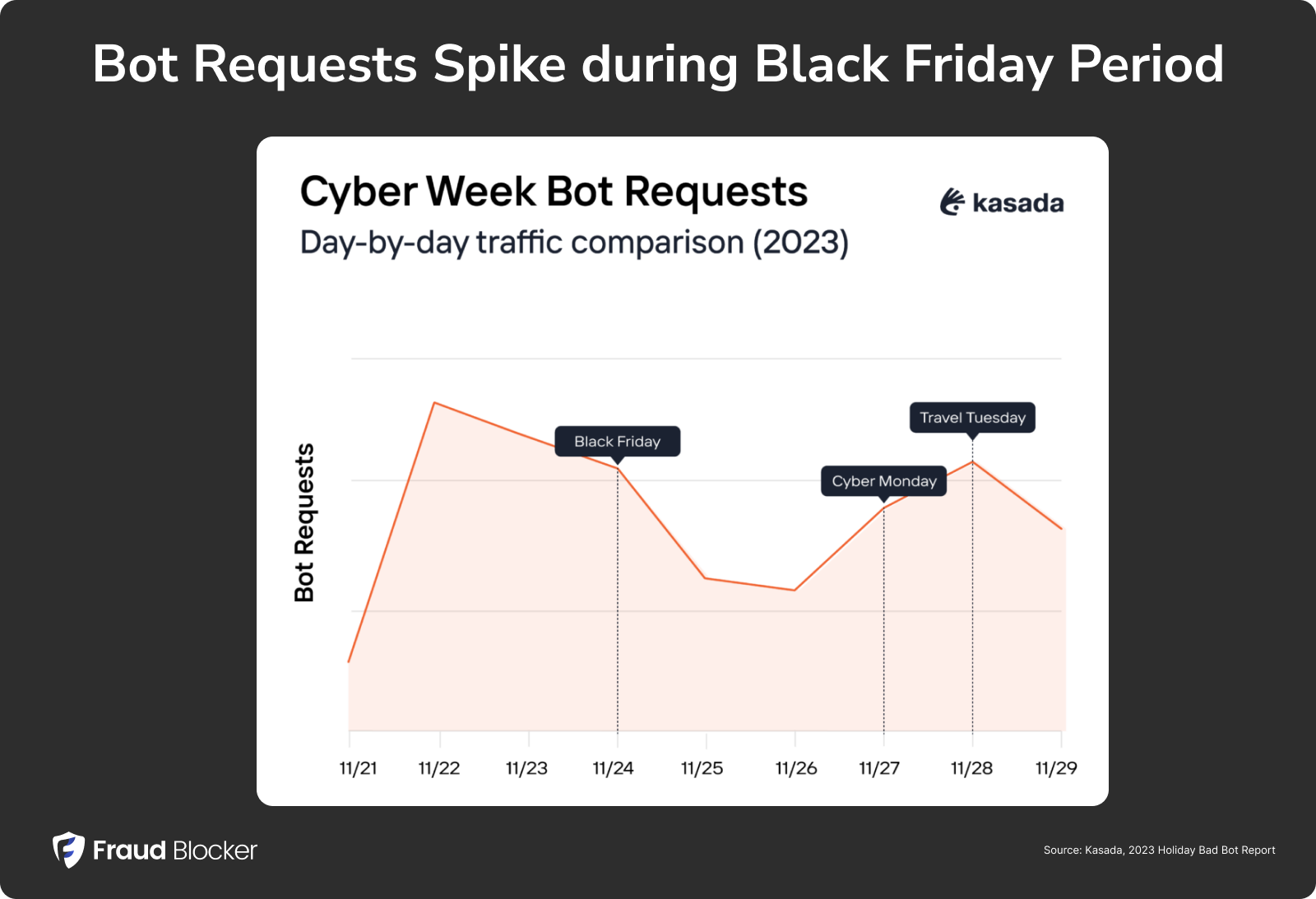
Fraud is always a constant during normal advertising periods (consider that 22% of all ad fraud is fraudulent), but it’s increased during black Friday and Cyber Monday. For one, Kasada found that bot traffic is 110% higher, and Radware found it accounts for 57% of all e-commerce website traffic.
So, a short window to reach costumes plus increased competition and elevated bot activity all compound the problem of click fraud during Black Friday. But that’s not the full story.
Black Friday changes the incentive for click fraud, and the potential payoff for bad actors.
When analytics software Triple Whale tracked 2024 Black Friday performance, they found that CPCs rose 3.10% to $1.53. Usually, when CPCs rise, CPAs follow. And Wordstream’s research shows just that. They reported that CPAs jumped 26.43% to $18.32 during the same period.
Two other stats stand out from the Triple Whale findings:
These metrics combined show it’s harder to get attention and get sales during the holidays. Some may be due to more deals/advertisers, but partially due to traffic quality from bots and bad actors.
For fraudsters, higher CPCs mean each fraudulent click costs you more and puts more money in their pocket. With competitor clicks, for example, that means malicious competitors can drain your budget faster since you’re paying more per click during that period.
Here’s what that might look like, in real-world numbers.
Let’s say you have a budget of $50,000 for a Black Friday campaign with an average CPA of $18.32. You’d be expecting roughly 2,730 conversions.
But with 22% of ad spend being fraudulent, that’s $11,000 wasted, or about 628 customers you’ll never reach. With Black Friday fraud spikes, this number is likely even higher.
The massive surge in legitimate shoppers during a holiday season is the perfect cover for increased bot traffic.
During normal periods, unusual traffic patterns stand out. A sudden spike in clicks from a specific location, an abnormal increase in bounce rates, or a cluster of clicks with identical behavior patterns are some of the best ways to detect click fraud.
When your site is experiencing 3-5x normal traffic volume, it’s much harder to tell the difference between an excited shopper clicking and “researching” multiple products, and a sophisticated bot. And with bots making up a staggering 57% of e-commerce traffic during the 2024 holiday season, fraudulent clicks can easily hide within legitimate shopping behavior.
Another source found data that corroborates this: invalid clicks for programmatic ads increased 50%+ (from 17% in Q2 to 25% in Q4).
Increasing reliance on automated bidding during Black Friday makes sense. It’s an easy way to handle the volume and pace of holiday shopping.
But outside of sophisticated fraud detection solutions, many algorithms can’t distinguish between genuine urgency and coordinated fraud activity.
These are some of the signals automated bidding systems optimize based on:
During Black Friday, when bots are mimicking human behavior at scale, all these signals can be easily spoofed. So, the algorithms interpret fraudulent engagement as high-intent traffic and they try to optimize your campaigns by increasing bids.
This inevitably creates a feedback loop that looks like this:
Manual oversight becomes nearly impossible at Black Friday scale, which is exactly why it makes sense to lean on automation. But that same automation, without fraud protection, can really hurt your campaigns, and your budget!
Waiting until Black Friday to address click fraud is usually too late. For one, you’re likely increasing spend days before actual Black Friday. And, by the time you’ve detected unusual patterns and adjusted your campaigns, the damage is done.
Real protection means a proactive approach that you put in place BEFORE the traffic surge begins.
Here’s how.
Use click fraud protection tools that monitor and block fraudulent traffic in real-time. These systems analyze dozens of signals, including traffic patterns, IP addresses, user-agent anomalies, and even inconsistencies in geolocation.
They also cross-reference normal traffic patterns to identify suspicious behavior during periods of spikes, and block malicious activity.
This, coupled with reporting, and email verification (in the case of solutions like Fraud Blocker) create a multi-pronged approach that stops click fraud before it drains your Black Friday budget.
The pressure to maximize reach during Black Friday often makes it easier to loosen targeting parameters and bid on broader keywords. But by doing so, you can open your campaigns to more click fraud.
It’s key to be more selective.
First, review your IP exclusion lists and refine your geographic targeting to match where your actual customers are, so you stop showing ads outside your target location.
If certain IP addresses repeatedly trigger suspicious clicks, block them immediately. Sources like Netacea have identified locations like Russia, China, and Vietnam as leading sources of bot deployment. But blocking a wide range of IPs could be problematic. A better approach would be to block addresses from locations that aren’t part of your customer base.
Next, use negative keywords aggressively to filter out low-intent traffic that bots typically target. Negative keywords can also help you filter out traffic from users searching for unrelated terms. This keeps your campaigns focused on legitimate customers actually searching for what you sell.
Explore our list of even more exclusions in Google Ads you can use to stop wasted spend.
If you’re building audiences in October and November in preparation for holiday campaigns, make sure to review them before the shopping season.
Remove suspicious traffic patterns, unusually short session durations, and users with no engagement history.
Cleaning your lists like this means you can improve conversion rates and stop wasting remarketing budgets on bots. But most importantly, it means Black Friday fraud has less existing contamination to hide within.
The sheer volume of traffic, clicks, and clickthroughs is part of how fraud is able to hide during Black Friday. But metrics like conversion rates and CPA can be much more helpful here.
If clicks are up 40% but conversions are only up 15%, fraud is a likely culprit.
You can set up automated alerts for unusual divergence between engagement metrics and actual conversions.

Click fraud activity ramps up during Black Friday and Cyber Monday because fraudsters stand to gain more.
But with such a narrow window to take advantage of the biggest sale of the year, you can’t afford to leave your campaigns unprotected, and low level fraud prevention efforts won’t cut it either. Proactive protection is the only strategy that works.
Fraud Blocker monitors your traffic patterns in real-time, and identifies and blocks fraudulent activity the moment the surge begins before it snowballs into a big problem. While automated bidding systems unknowingly optimize toward sophisticated bots, Fraud Blocker ensures your budget reaches real shoppers ready to convert.
Start a free 7-day trial today and see how Fraud Blocker protects your campaigns.