

Performance Max Pros and Cons in 2027: What Google Fixed and What Advertisers Still Need to Control
Performance Max has improved a lot since 2023. See what Google fixed, what still needs your attention, and how to run PMax effectively in 2027.



Our AI agents catch the sophisticated fraud others miss and it tells you why. Learn more here.



Click fraud is costing advertisers billions in loses. Learn more here.

Click fraud is costing advertisers billions in loses. Learn more here.



Read our in-depth study by independent research firm Juniper Research.



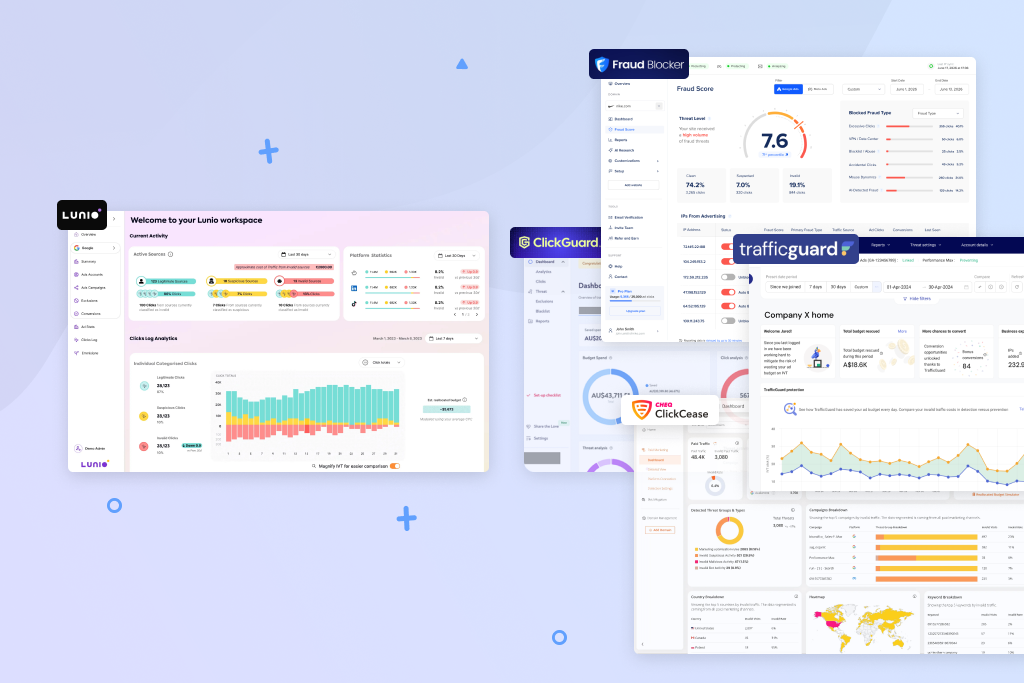
Lunio is a solid click fraud tool; it covers 11 ad platforms and syncs fraud signals across all of them so one flagged IP gets blocked everywhere. But it charges a percentage of ad spend, not your click volume like other competitors. That means the more your campaigns grow, the more it costs to stay protected, a real drawback for advertisers scaling up.
Below, we break down Lunio’s strengths, weaknesses, and the best alternatives for protecting your campaigns without the growing price tag.
Lunio (originally PPC Protect) uses a self-learning algorithm to block invalid clicks across 11 different ad platforms. This is its standout feature. With this wide coverage, Lunio connects fraud signals across platforms so that IPs flagged in one platform can be excluded across every channel you’re connected to.
Initial setup takes only a few minutes, but the platform offers several customization options for advertisers to adjust their campaign monitoring. Everything from click thresholds and frequency caps and even custom rules can be user-defined.
Unfortunately, Lunio is not a perfect platform, and the biggest complaint advertisers have is the lack of transparent pricing. As one G2 user put it, “The pricing isn’t very transparent up front, which can make it harder to evaluate at the start.”
Billing friction is also cited as another challenge, as there’s no cancellation option clearly visible on the dashboard. There’s also a steep learning curve with Lunio due to all the customization options and analytics available. As a result, it may take some time to explore and understand the platform. As one G2 user said, “You need to spend some time exploring in depth the analytics features.”
Removing tools like Lunio from your stack isn’t the answer, as click fraud protection is still necessary. Our analysis of 200 million Google Ads clicks found blatant instances of click fraud, including location hopping, fingerprint spoofing, and bots presenting as real users. Google’s filters failed to catch many of these.
Below, we share alternative tools that can protect your campaigns from click fraud while improving on Lunio’s shortcomings.
These are especially useful if you’re looking for fairly priced options (because Lunio’s pricing is a percentage of ad spend, your cost increases with your budget, not your click volume or fraud rate). If you’re comparing products that don’t have these shortfalls or looking to switch from Lunio, consider the tools below.
Best for advertisers who want granular blocking rules per campaign, instead of blanket settings.
ClickGuard offers advertisers 50+ configurable features and campaign-level rules that let advertisers control how fraud is detected and blocked on their campaigns. This contrasts with Lunio, which doesn’t offer as many options for granular configuration.
ClickGuard starts at $89/month for $5k in monthly spend and offers analysis of unlimited clicks on every plan tier.
The tradeoff here is setup time. “[ClickGuard] takes quite a lot of user know-how to set up,” as one Capterra reviewer put it. A related complaint is the lack of automation options, especially for larger accounts. As there are no self-learning models doing the heavy lifting, teams end up building and maintaining rules manually, which can get time-consuming across multiple accounts.
Choose ClickGuard if you want to set your own blocking rules per campaign instead of leaning on an automated system.
Best for Google and Meta advertisers who want transparent pricing and a visible fraud score per click.
Fraud Blocker is built for advertisers running Google Ads and Meta looking to pay for just the features they need. The tool is praised for its proprietary Fraud Score, which assigns each visitor a score on how likely they are to be bots. This transparency means advertisers can see precisely which clicks were flagged and why.
While it has a focused scope on specific platforms, Fraud Blocker offers a few features beyond just blocking fake clicks:
Fraud Blocker also has transparent pricing, beginning at $79/month for 5k ad clicks and 90-day data retention.
One of the biggest criticisms of Fraud Blocker was the lack of protection for Meta ads, as one G2 reviewer stated. But the platform has since extended protection to cover ads on Meta’s platform.
Another complaint has to do with the platform’s scope: Fraud Blocker focuses on protecting Google and Meta ads, so advertisers running TikTok or programmatic campaigns will need broader coverage.
Choose Fraud Blocker if you want transparent pricing, a visible fraud score for each blocked click, and protection sized to the platforms you use.
Best for app marketers who need install-fraud protection integrated with their existing mobile attribution stack
AppsFlyer is a mobile measurement partner that helps you track your campaigns. The Protect360 solution is the ad fraud layer that monitors the entire install funnel, from click and install to first open. It’s a strong choice for marketers running mobile app campaigns because it covers both attribution and fraud protection in one platform.
Protect360 is integrated into the platform running your attribution, so there’s no lag between installs and fraud checks. The system is able to catch fraudulent installs before payout, protecting your campaigns.
AppsFlyer offers 12k free conversions for the first year. After that, conversions are priced at $0.07 per conversion.
Advertisers complain that AppsFlyer can be expensive across the board. One reviewer stated that the costs for larger companies are “high and sometimes hidden costs, particularly the “per install” pricing model.” Another concern is that Protect360 is a small part of a larger offering. Teams that only need click fraud protection for mobile app campaigns will end up paying for measurement infrastructure they don’t need.
Choose AppsFlyer if mobile app install campaigns are central to your overall strategy and you want fraud protection connected directly to your attribution platform.
Best for teams that want published pricing plus visual proof of fraud through session recordings
ClickCease is the largest click fraud tool in the SMB market, and it adds two features Lunio doesn’t have at all: session recordings (allows you to see how a flagged visitor interacted with your site) and AdSpy, which tracks competitor ad copy and keywords.
ClickCease pricing begins at $99/month and is published upfront, another reason to choose it as a Lunio replacement. One Capterra reviewer reported seeing a difference in traffic quality the day the tool was connected.
But on the flip side, pricing is based on 5,000 protected visits for one website. According to ClickCease, this includes any traffic ClickCease inspects, internal page views included. That means that if your site has heavy organic traffic, you’ll burn through the ‘credits” faster than your ad-click count suggests. Reviews mention ClickCease’s pricing being “very high cost compared to the value provided.”
Choose this if you want published pricing and visual proof of fraud (session recordings). But beware of the high price point.
Best for advertisers who want one standalone tool covering both search and mobile app fraud
TrafficGuard is the only tool on this list with coverage for mobile app fraud, and that’s one point where it has Lunio beat. The tool has a lot of positive reviews, with advertisers praising its ease of use and overall effectiveness.
The tool costs $49/month for up to $30k/month in ad spend. Beyond that, it’s priced at 2% of your total ad spend.
One of the biggest cons is the pricing; at 2% of your total spend, it can rapidly become expensive. Especially for advertisers spending more than $30k monthly. The jump from $49 to enterprise-level pricing can be unsuitable for non-enterprise businesses looking for the best value.
Choose TrafficGuard if mobile app install fraud is a real problem in your campaigns, alongside your Google Ads protection needs.
Best for advertisers running campaigns across 30+ platforms beyond just Google and Meta
Spider AF is a great alternative to Lunio, while also delivering more features to advertisers. Its protection covers 30+ ad networks, and it can also scan your website for script vulnerability and offers fake lead protection as part of the tool suite.
Spider AF pricing starts at $150/month for ad fraud protection, covering up to 500k monthly clicks.
The biggest concern with Spider AF comes from smaller teams that need to evaluate their budget, as stated by many reviews. It is generally more expensive than most of the tools on this list. One user on G2 also talked about getting more insight on exactly what’s being blocked. This lack of transparency is a pain point for many users, especially considering that many other fraud prevention tools show the reasoning behind every blocked click.
Choose Spider AF if you’re running campaigns on multiple platforms beyond Google and Meta. Lunio only covers 13, but Spider AF covers 30+.
| Feature | Lunio | ClickGuard | Fraud Blocker | AppsFlyer | ClickCease | TrafficGuard | Spider AF |
|---|---|---|---|---|---|---|---|
| Published pricing | No. Sales quote only | Yes, from $74/mo | Yes, from $79/mo | Free tier, then ~$0.07/conversion | Yes, from $99/mo | Yes (free tier + 2% of spend) | Yes, from $150/mo |
| Contract / lock-in | No self-serve cancellation | No lock-in on lower tiers | No lock-in, cancel anytime | Pay-as-you-go and annual contract options | 3-month minimum lock-in for higher tier plans | No lock-in on Shield plan | No lock-in stated |
| Google Ads | Yes | Yes | Yes | Not offered | Yes | Yes | Yes |
| Meta Ads | Yes | Yes | Yes | Not offered | Yes | Yes | Yes |
| Microsoft Ads auto-blocking | Yes | Yes | Not offered | Not offered | Detection only | Not supported | Yes |
| Lead / form verification | Not offered | Not offered | Yes. Real-time email verification on lead forms | Not offered | HubSpot forms only | Not offered | Yes |
| AI-powered traffic reporting | Not offered | Not offered | Yes. Plain-language AI reporting (beta) | Not offered | Not offered | Not offered | Not offered |
| Behavior analysis | Yes | Yes | Yes | Yes | Yes | Yes | Yes |
| Automated negative keyword exclusions | Not offered | Not offered | Yes. Instant Performance Boost auto-generates negative keywords | Not offered | Not offered | Not disclosed | Not disclosed |
| Mobile app install fraud | No | No | No | Yes | No | Yes | No |
| Free trial | Not offered (demo only) | 7 days | 7 days | Free tier (capped at 12k lifetime installs) | 7 days | Free monitoring tier | 14 days |
Sources: vendor pricing pages, G2, and Capterra as cited throughout this article. Feature availability reflects publicly disclosed information as of August 2026 and may change.
Most Lunio alternatives offer the same foundational protection with additional features and add-ons. The one you choose should depend on your ad spend, ad platforms, and priorities.
For many advertisers, Lunio’s broad list of features comes with an opaque pricing plan that makes it hard to evaluate and compare. If you’re looking to switch or simply comparing options, Fraud Blocker is an excellent alternative for you, especially if your advertising is centered around Google Ads and Meta.
For more specific needs, the other tools here are incredibly valuable: ClickGuard for granular rule control, TrafficGuard for mobile install fraud, and Spider AF for platforms beyond Google and Meta.
You can start with a 7-day free trial of Fraud Blocker.

ABOUT THE AUTHOR
Matthew is the resident content marketing expert at Fraud Blocker with several years of experience writing about ad fraud. When he’s not producing killer content, you can find him working out or walking his dogs.
Matthew is the resident content marketing expert at Fraud Blocker with several years of experience writing about ad fraud.